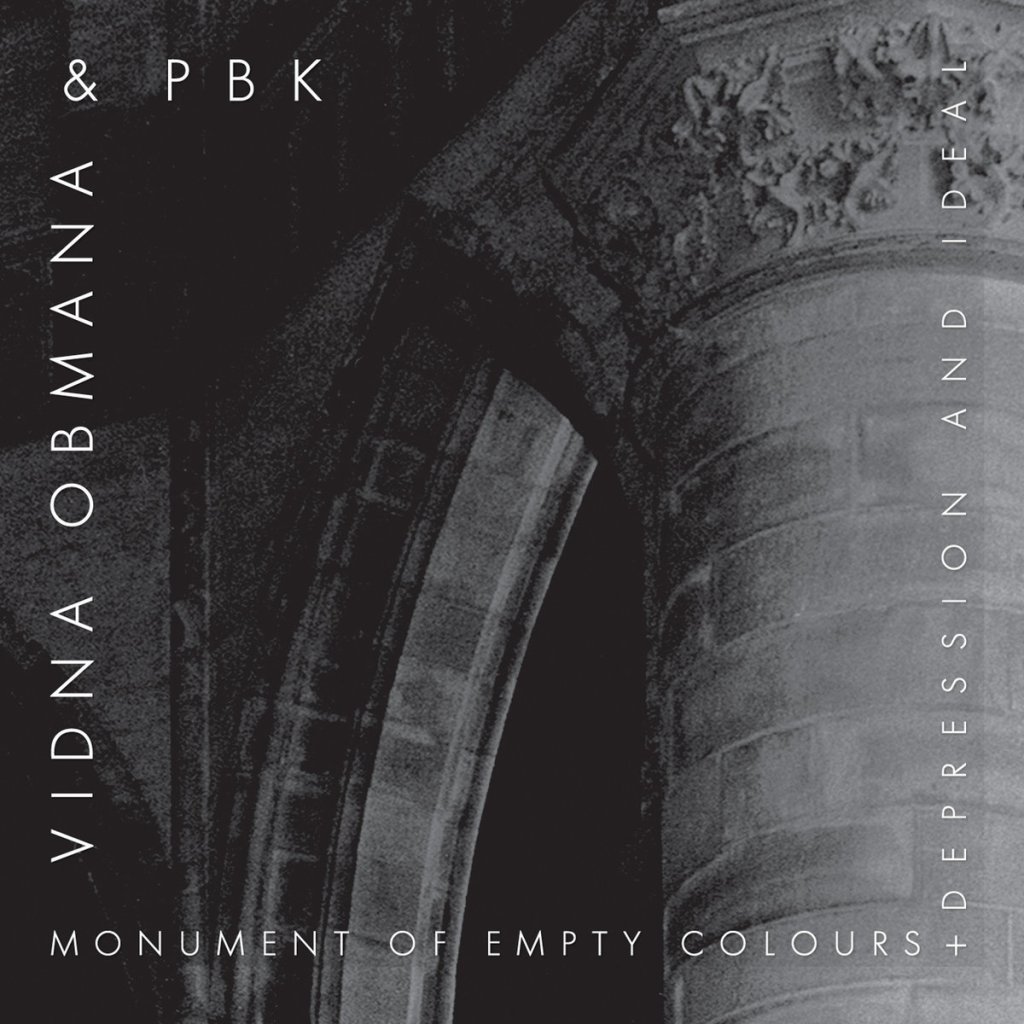
Belgium’s DARK ENTRIES just reviewed VIDNA OBMANA & PBK’ MONUMENT OF EMPTY COLOURS/DEPRESSION AND IDEAL, a 2CD reissued on the Polish ZOHARUM. Available here.
DARK ENTRIES REVIEW :
Het Poolse cultlabel Zoharum brengt heel wat heruitgaves uit. Hun heruitgaves van aan dark ambient verwante projecten als het Belgische ritualproject Hybryds of het Britse etno-ambient-project Rapoon waren reeds erg populair. Ze brengen ook al een tijdje heruitgaves van het werk van de Belgische ambient-artiest Vidna Obmana – de naam is Servisch voor ‘gezichtsbedrog’ – uit, een man die trouwens een tijdje bij Hybryds speelde.
Vidna Obmana bracht van 1984 tot 2007 extreem veel ambient-muziek uit, maar verkoos om daarna onder zijn eigen naam Dirk Serries te werken, wat niet betekent dat hij minder productief werd. Wij tellen tussen 1984 en 2007 niet minder dan 87 uitgaves onder de naam Vidna Obmana, al dan niet in samenwerking met anderen, maar het kan zijn dat we sommige uitgaven dubbel gerekend hebben. Het gaat alleszins om heel veel werk, en dan zijn we blij dat Zoharum ons helpt om een keuze te maken in deze overvloed.
Deze heruitgave – de negende al van Zoharum, waarbij u moet weten dat sommige heruitgaves verschillende platen van Vidna Obmana verzamelen – focust op de samenwerkingen met PBK aan het eind van de jaren 80. Het eind van de jaren 80 was sowieso een extreem productieve periode voor Vidna Obmana. PBK is een afkorting van Phillip B. Klinger, eveneens een prolifieke ambient-artiest uit Flint, Michigan in de Verenigde Staten in die periode.
Ook deze heruitgave bevat twee verschillende platen: ‘Monument Of Empty Colours’ en ‘Depression And Ideal’, die allebei in 1989 uitkwamen op cassette, zoals destijds gebruikelijk was voor dit soort muziek. U mag er gerust van uit gaan dat de platen in elkaars verlengde liggen, en dat u dus dubbel kunt genieten van deze box. Het is niet helemaal duidelijk of de opnames het resultaat zijn van de reizen die Dirk Serries destijds naar de Verenigde Staten maakte, dan wel of de twee artiesten cassettes met opnames naar elkaar stuurden die ze telkens aanvulden en terugstuurden.
Languitgerekte tonen – soms zelfs met het gevoel dat je naar een wedstrijd zit te luisteren van hoe lang iemand eenzelfde akkoord kan aanhouden – voeren hier de boventoon. Maar wie aandachtig luistert zal tal van interessante details opmerken, want waar ambient vooral rust en traagheid moet uitstralen, is het vaak de kunst om dat niet al te repetitief of eentonig te doen. Die kunst verstaan Vidna Obmana en PBK, maar dat zal slechts slechts voor geoefende luisteraars duidelijk worden.
We kunnen zeker stellen dat de samenwerkingen tussen Vidna Obmana en PBK een succes waren. Ze hebben trouwens vaker samengewerkt dan enkel op deze twee platen, maar Zoharum vond het legitiem om deze twee collaboraties te bundelen, daar ze tot het meest expressieve werk van de twee heren behoren. Dat wil ik graag geloven, want hoewel ik al behoorlijk wat platen van Vidna Obmana heb liggen, spreekt deze dubbel-cd me in het bijzonder sterk aan.
THE SOUND PROJECTOR REVIEW :
Vidna Obmana is, along with Rapoon and Genetic Transmission, an artist whose back catalog this label reissues with a generous hand. The latest package contains two discs, Monument of Empty Colour and Depression and Ideal (ZOHARUM ZOHAR 275-2), both of them collaborations with PBK, the American 1980s veteran Phillip B. Klingler, likewise prolific ambient-noise-electro-acoustic genius who has collaborated with Artificial Memory Trace, Illusion of Safety, Government Alpha, and many others.
Monument originally came out as a cassette in Belgium in 1989 on Dirk Serries’ own Decade Collection label, a vanity press imprint that managed but six releases. I’m certainly enjoying the bleakness and ambiguity of this one, which feels like it has a lot more meat and sinew to it than Vidna manages when left to his own devices. The original cassette had a cover photo where a beckoning cathedral glass tower in the distance was separated from us using a cast-iron gate, suggesting a somewhat foreboding scenario. Even the title ‘Door of Secret Rising’ is part of that scenario, in my fantasy version; perhaps a latter-day Gothic novel of a castle with many hidden compartments. (The digipak of today’s release attempts to emulate the spirit of that image, but it’s too subtle and tasteful). If we are dealing with modern masters of sonic horror here, we can reckon Monument as a successful meeting between Dr Frankenstein and Manfred from the Castle of Otranto. I expect the means and methods (electronics, loops, tapes) are quite simple and basic at some level, but my word how these two manage to imbue their devices with occult powers.
The second disc is occupied by Depression and Ideal, another substantial array with six long-form tracks; also originally from 1989 and released on Mr Klingler’s own PBK Recordings label in California (though there’s also a Canadian version from Freedom in a Vacuum). The original cover art was one of those examples of vague, abstract imagery that was once so much in vogue – maybe a close-up of some granite boulders showing the grain, plus inside some splotches of black blood or Jackson Pollock thrown paint. Where Monument above achieves a lot of its unsettling power through loops and more loops, this Depression item is aiming for a rather terrifying pitch of intensity, slowly ratcheting up the levers of pain one notch at a time. Another characteristic is a certain dissonance, a sense of one too many frequencies competing for the ether; if on Monument the two of them agreed on common ground for their experiments, now the air has soured and the mood has turned to one of brooding contempt. You can start to see why this sort of blank, neurotic and troubling music appealed so much to depressives and shut-ins of the late 1980s, who at the time had no other outlet for expressing their unhealthy mental states; now of course they’ve all become internet trolls and incels. I jest, of course…in all seriousness, these are two great examples of post-industrial art music that tend to reach the parts that even contemporary dark ambient and dungeon synth cannot touch.
I’ve tended to feel a bit surfeited by these many Vidna Obmana projects, but this one will be a keeper and may even make me wish to investigate some of the past output of PBK. From 10th January 2023.
CHAIN D.L.K. REVIEW :
“Released by the Polish cult label Zoharum, this double-CD set reissues two seminal works from the late 1980s, initially distributed on cassette — a medium that perfectly matches the raw, unfiltered essence of the tracks.
The first of the two collaborative releases, aptly titled “Monument of Empty Colours”, dates back to 1989, and was the very first release under the imprint of Decade Collection, the private label that Dirk Serries (notoriously the man behind Vidna Obmana darkening curtains) made for some stuff signed under the seal of this moniker. Imagine a sonic cathedral, echoing with prolonged, haunting tones that make you question whether you’re listening to music or experiencing a spectral presence. The Belgian ambient maestro Dirk Serries collaborated with PBK (acronym of Michigan-born experimental sound artist Phillip B. Klingler) to create an atmosphere thick with eerie loops and lingering harmonies. The album embodies a mysterious, almost gothic quality, besides being a possible forerunner of what was labeled as dark ambient some decades later. Some listeners could feel like being in a forgotten, abandoned chapel where every sound is a ghost of its former self, whispering secrets through decayed frequencies.
If “Monument of Empty Colours” can be matched to an imaginary (or concrete!) haunted cathedral, “Depression and Ideal” could be its dilapidated crypt. The second CD in this collection intensifies the experience, with six long-form tracks that slowly ratchet up the tension. Released on PBK’s own self-named label (but I saw that there should have been a second edition on the Canadian label Freedom In A Vacuum) in 1989 as well, the album utilizes dissonant soundscapes and overlapping frequencies to evoke a sense of creeping unease. It’s a perfect soundtrack for your existential crises, providing a soundscape that is both suffocating and strangely cathartic.
Both albums showcase a mastery of ambient sound manipulation. The collaboration between Vidna Obmana and PBK is seamless, blending electronic loops, tape recordings, and ambient noises into a cohesive, unsettling whole. It’s a testament to their ability to transform simple sound sources into complex, emotionally resonant compositions. The original recordings’ analog warmth adds an extra layer of texture, giving the music a timeless quality that digital clarity often lacks.
Ironically, despite the intense melancholy and darkness that permeates these tracks, there’s a peculiar comfort in their predictability. You know that each track will take its time to unfold, much like a dreary yet familiar rainy day. It’s music that doesn’t rush to its conclusions but instead revels in the slow, almost torturous development of its themes. For listeners, this can be oddly reassuring—a sonic equivalent of knowing that at least the storm outside is consistent, even if it’s bleak.
In conclusion, “Monument of Empty Colours” and “Depression and Ideal” is not for the faint of heart. It’s a demanding listen, one that requires patience and a taste for the somber. But for those who appreciate the darker side of ambient music, this reissue is a treasure trove of moody, introspective soundscapes. Whether you’re a long-time fan or new to the works of Vidna Obmana and PBK, this double-CD set is a monument to their enduring legacy in the ambient genre.”
 dirkserries.com