I had the pleasure and honour a few weeks ago to talk on my weekly radio show, “Between the Grooves,” with Belgium-based Dirk Serries — a sonic artist of longstanding.
I play Dirk’s music quite regularly on my overnight show, “Night Lights with Malcolm Burn” on Radio Kingston in Kingston, New York. If you don’t know Dirk’s work and you enjoy ambient and experimental music that has the ability to transport you to another state of mind, you need to look him up and explore his discography.
Malcolm Burn’s The Long Way Around Substack is a reader-supported publication. To receive new posts and support my work, consider becoming a free or paid subscriber. Go here.
Dirk has experimented with music on the border between avant-garde, industrial, experimental and ambient for close to 40 years now. He released his earliest work (1984) behind the pseudonym vidnaObmana up to 2007 when he closed the book on this project (realizing an extensive discography). In October 2013, Dirk Serries re-booted his classic vidnaObmana ambient sound from the mid-1980s/early 1990s. In contrast to his original music that was mostly synth-based, this ambient music is constructed on electric guitar. Dirk also runs the A New Wave Of Jazz label, dedicated to free improvisation and minimal avant-garde.
Through his experience in the free improvisation Dirk transformed his solo ambient music, originally constructed meticulously by writing strict motives before performing, to being able to improvise 200% and still create his trademark ambient music for which he is recognized worldwide.
“All of this started from the time I was a kid and enjoying early film soundtracks, which fascinated me to the extent that I thought, this would be really cool to make myself,” says Dirk. “It somehow sparked sort of an obsession… it’s not a hobby, it’s not a profession. For me, it’s an obsession — it’s part of who I am, part of my DNA, so to speak.”
We talked about the creative process. “For me, despite how you have to describe your music, for me it’s always been part of an ongoing search for that refinement in sound, and how it would trigger me as a musician to go deeper into something I would love to listen to myself,” says Dirk. “It’s part of an external world that you create for yourself and that’s where I love to be [in].”
Every musician has his ups and downs in realizing — who am I, what am I doing here, is this worthwhile to do? — and I do have that, as well,” says Dirk. “But each time I’m drawn back into it just because of the fact that it just feels comfortable with sitting in that world of sound whatever it is — if it’s an ambient record, an experimental jazz record… it’s all part of one continuing organism that grows, that expands and changes over time as I am, as a person.”
I think it’s fascinating that Dirk puts it this way because I experience the same thing. It’s the same kind of compulsion that I have, if one can call it that. There are a lot of other things that I could be doing in a day but this is what feels like it matters the most. Whether anybody else cares or not it’s not relevant.
Dirk agrees: “It’s a pretty egocentric situation you’re in but it’s also a very therapeutic situation — I feel good about it because there are a lot of things going on in the world, unfortunately, which are not that positive. The music, the sounds, the little space you create for yourself — these are things which I feel comfortable sitting in and from the moment you’re really in there and it works and the music gels, you feel really nicely despite the fact, indeed, whether you will share it with people or not, with the audience.”
“The Stars Sublime” — Dirk Serries — The Might of Stars Sublime (April 2025)
“As a musician you go through phases although it’s all in the same genre but still you have these kinds of variations on the aspect of recording soundscape music. This piece really resembles a little bit of everything I have been doing over these past 40 years. It’s a really beautiful introduction to who I am now,” says Dirk.
“There are different rules to creating such a soundscape although you could easily record it or compose it in a shorter time,” says Dirk. “I always admired Brian Eno and Daniel Lanois when they did their ambient works together. A couple of those songs are pretty short but they still work, and keep the slow pace, as well, so that nothing is abrupt, nothing is really produced in sort of its own level that really changes the entire mood of the songs. It’s artistry.”
This brought back the memory of when I was young and was listening to Pink Floyd’s “Dark Side of the Moon.” When I listen to that record now years later, having made albums and knowing how they’re made, I realized that record was made like a pop record. It wasn’t a pop record, per se, but all the pieces, for instance, even “Us and Them” and some of those tracks are six minutes long but somehow they seem longer. I think there’s an art form to that.
I asked Dirk how he would describe the relation between a keyboard instrument and a guitar in terms of the two instruments’ expressiveness. “That’s a good question and also a difficult question to answer,” says Dirk. “It took me a long time to actually get to the guitar. I started out as a young kid. My first synthesizer was a Korg MS-20 — great sounds and unpredictable, as well. That was all part of my discovery of sound and I stuck to that for a long time. I moved onto digital work stations like the Korg M1 and the wave station and your recording equipment evolved from the 2-track cassette (and 4-track cassettes). Younger listeners will probably never know what happened back then.”
“Also there was the saturation of it when you bounce it because your sound changes over time and back then you had to know that up front,” says Dirk. “Because you knew there was no way back. All these things evolved for me and created such a huge machine to operate because when the computer came, the multi-track and all the editing … and all the synthesizers together … it actually burned me out.
“At that point, I had already introduced the guitar a little bit in my music,” says Dirk.
“After I had recovered from the burn-out…, I sold all my synthesizers. And left over was one very cheap electric guitar and I started from scratch,” says Dirk. “Could I play guitar? No. I couldn’t really play it well then and I still don’t at this point call myself a guitar-player.”
I think that’s the beauty of the guitar. I use a lot of open tunings. I never change my strings. There are a lot of weird, funny things that I do that are very individual; and we invent those things for ourselves. Think of Jimi Hendrix with his guitar upside down and strung the other way up and playing, etc. These are all things you can do with a guitar. Whereas with a keyboard, you press the key and that’s the note that comes out.
Dirk agrees. “The guitar is very organic whether it’s an acoustic or electric guitar,” says Dirk. “Of course, there are big differences. It’s how you apply it, how you take it into your hands. The guitar is an extension of who you are at that point and I learned despite the fact that I was kind of an anti-guitarist. It made me discover a tool (I prefer to call it a tool) that I got so comfortable with over time. I’ve more and more started to play actual real chords on the guitar and incorporate it in my music but keep it experimental. Keep it not really too tonal.”
“This opened a different kind of spectrum for me,” says Dirk.
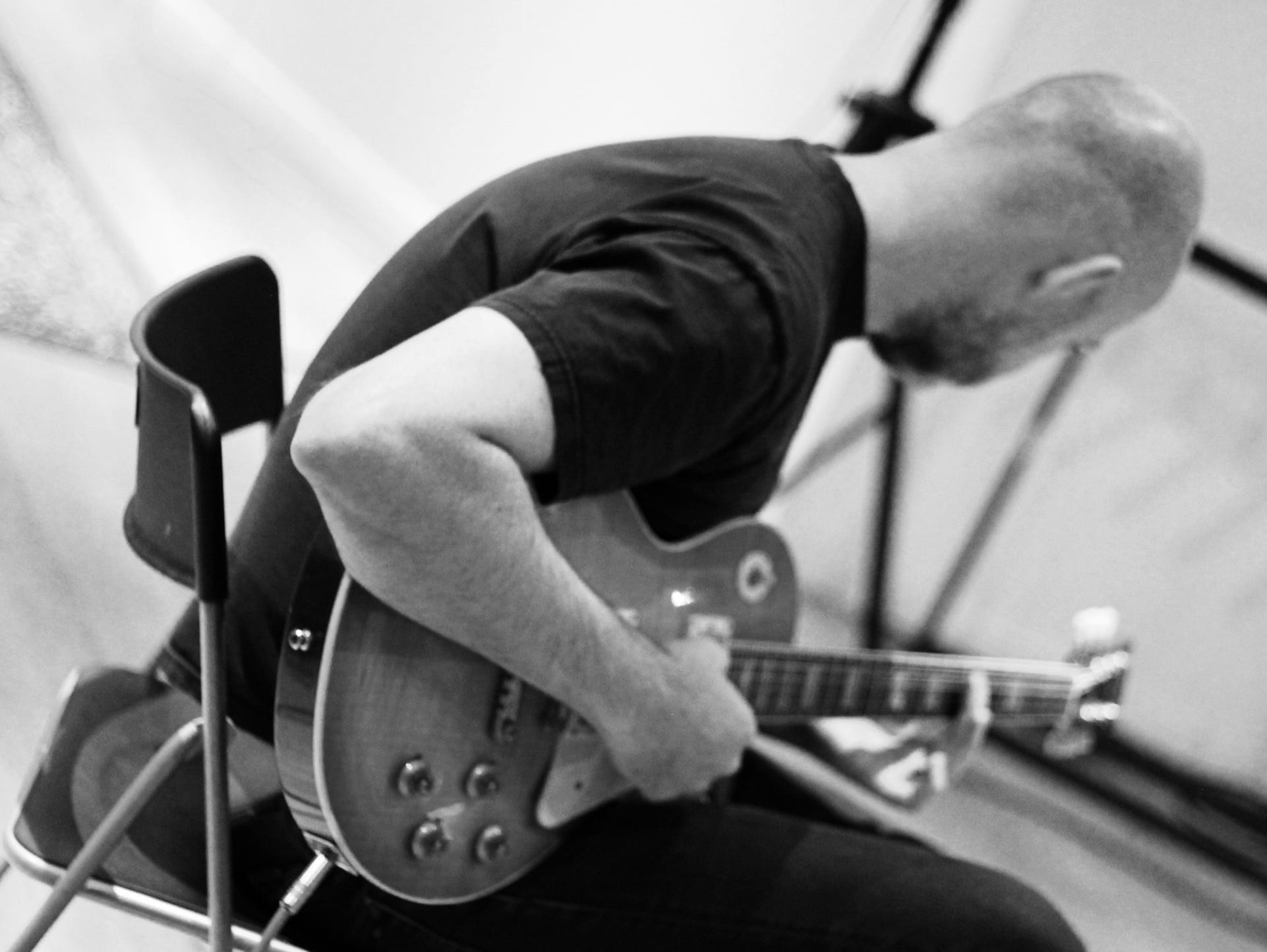
Photo by Shaun Cullen
I asked Dirk how he would describe his music — that is, the kind of music that he’s generally the most enthusiastic about creating. “This goes in phases,” says Dirk. “I also have a label for free jazz and experimental improvised music which I do with a lot of sound colleagues from London, Germany, Holland and from Belgium. That’s a different part of me. If somebody would ask me what kind of music I make, I would prefer to say just experimental music, which I think really covers a lot.”
“Who I am as a musician is that I’m also a huge listener of music and always want to discover new music,” says Dirk. “That’s how I learned about musicians, such as Hirotaka Shirotsubaki, classical music … and Emmylou Harris, who I discovered later because of the “Wrecking Ball” album, and that’s our connection.”
“This is what opened up my ears and my mind to other music; you discover that a lot of other people doing other music also listen to your music, which you would never expect,” says Dirk.
“If you would ask me now about my five favorite musicians, that would be impossible to do because you listen to so much music and in every little corner of a particular genre you will discover a new musician or an old musician who was already there for a long time but you never knew before and then they become part of your playlist, so to speak,” says Dirk.
I believe if there is one musician that we could all despite our musical tastes agree on it would be Jimi Hendrix. He was someone who changed music forever. Nobody was playing loud like that, bending the notes, etc. It’s hard to think about music before Hendrix. That sense of musical adventurism, I think, is something that he left behind for all us to learn from. Keep pushing wherever you can go with it and experiment. John Coltrane is another good example.
“Yes, this is very interesting and also signifies, I think, how important these musicians were back in the day, although they lived short lives,” says Dirk. “They touched upon something so unique you can’t really think about the pre-Jimi Hendrix or pre-John Coltrane, it’s mind boggling.”
Passage Dawn — Dirk Serries — Streams of Consciousness (A Series of Works by Dirk Serries, 2025)
I asked Dirk what format he works in as there are so many options available now. “I work with an Apple computer,” says Dirk. “I used to work with Pro Tools. But it’s not really compatible with all the plug-ins. I work now with Reaper, a software that’s very intuitive, very user-friendly and is compatible with all the plug-ins you want to use.”
“For young musicians who just stumble into the music scene, I think it’s also pretty overwhelming because I’m afraid they will lose the sense of the beauty of creating music because you’re so absorbed by the huge possibility of [too many] options,” notes Dirk.
I personally think that having too many options is the death of art. For example, the Abstract Expressionist American artist Jackson Pollock did something original in his art when he threw cans of paint on his canvases. Many people have tried to recreate that but they don’t and can’t. What Pollock did was unique and original. He was the first. It’s the same with music. You can make all kinds of fancy sounds but there still has to be some kind of heart and soul in there that comes from being a musician.
“Art itself has always been approached as being the more intellectual, especially the visual arts,” notes Dirk. “You have music as entertainment. But there is way more to music.”
“the ultimate drone album. My bible of inspiration from two amazing artists : Brian Eno with his legendary 80s ambient records (foremost ON LAND) and Robert Fripp’s own Frippertronics (think of LET THE POWER FALL and A BLESSING OF TEARS). NO PUSSYFOOTING still underrated, to my humble opinion.”
The Heavenly Music Corporation II — Robert Fripp, Brian Eno — No Pussyfooting (1973)
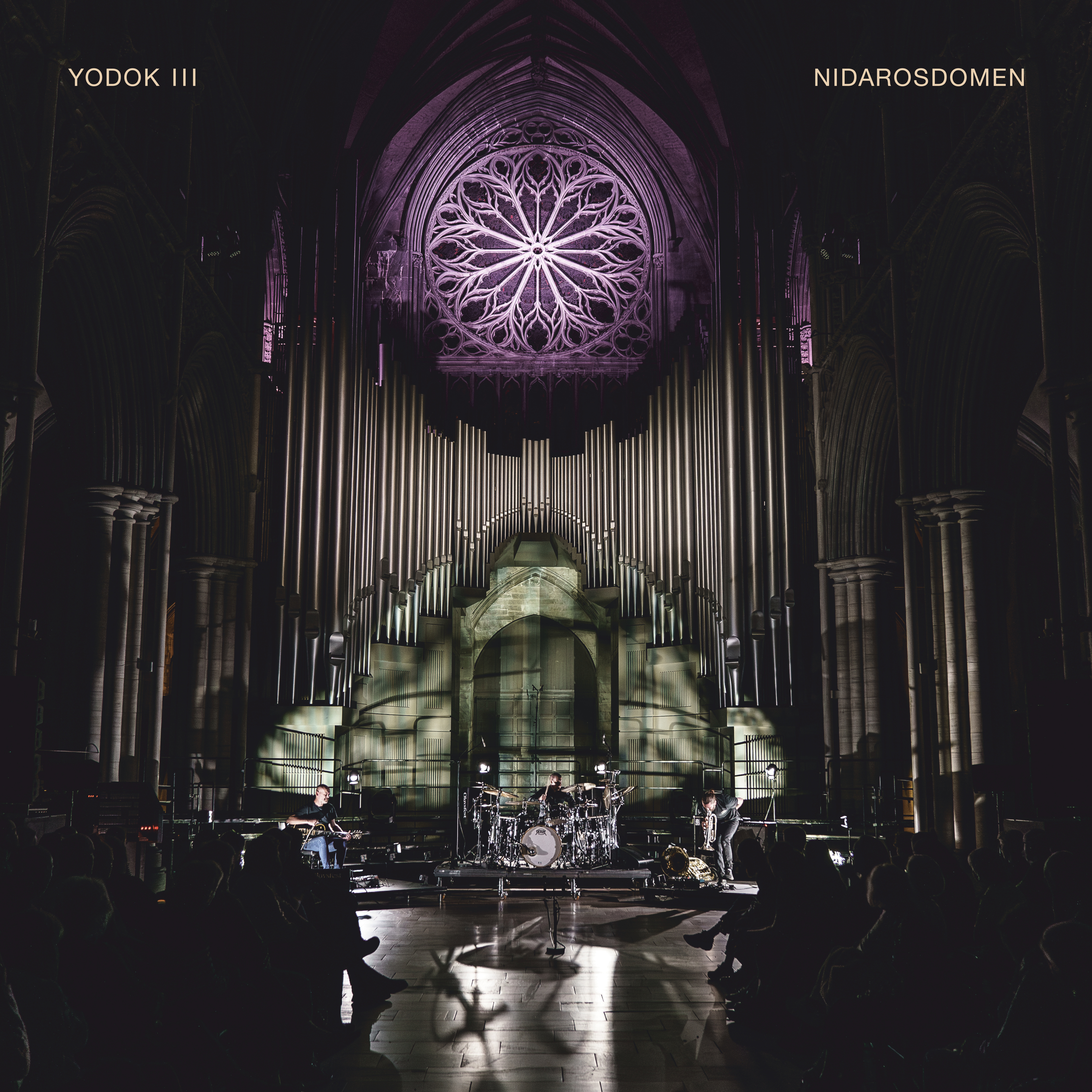
The best way to find Dirk is at his website: https://dirkserries.com/. His music is on many platforms, including Spotify and Bandcamp. Many of his live performances are on YouTube. Dirk also has a new, magnificent release — “YODOK III – NIDAROSDOMEN.” It will be officially out on September 19 but pre-ordering is now available through Consouling Sounds. After September 19, copies will be sold on Bandcamp. Check out the album teaser on YouTube.
Dirk chose a few more excellent tracks for our talk that we didn’t have the time to play on the show. I’ve included them here for your listening pleasure.
“from his vast and impressive catalog it’s difficult to choice, but this piece is one of my absolute favorites as it resembles everything I got to know Steve for, when I met him personally becoming good friends and collaborators. This piece blends in just a pitch-perfect manner the esoteric and spacious character of his music with the tribal-infused phase in his oeuvre.“
The Origin of Artifacts — Steve Roach — Artifacts (1994)
M.B. 55 T.D. 56 — Maurizio Bianchi — The Plain Truth (1983)
Listen to our entire one-hour talk here. Start at 1:01:17.
 dirkserries.com