This Friday, December 1st, we’ll launch the pre-order for the next installment in our vinyl series. This time it’s the great COLIN WEBSTER with a new solo album to grace our label. Recorded at the Oude Klooster Chapel in Brecht (Belgium), TEXTURAL STUDIES is a collection of abstract, minimal, repetitive, and introspective pieces Colin performed on the alto sax in relationship to the unique acoustics of the chapel. To be released on 140-gram black vinyl and limited to 100 copies with liner notes by Guy Peters and the design by Rutger Zuydervelt. The links will come online this Friday.
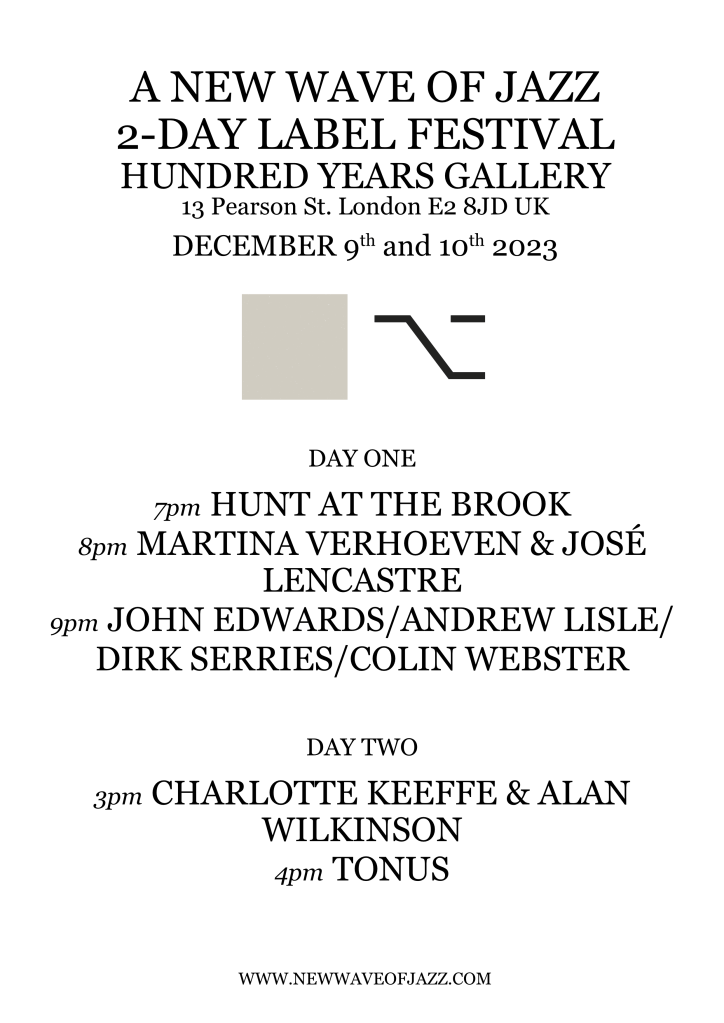
With our label we’re returning to our favorite spot in London, HUNDRED YEARS GALLERY, for another two-day label festival. In 2019 we landed there for a fantastic gathering of kindred spirits and this year will not be any different, resembling the output of our label but simultaneously welcomes new members and exclusive constellations. Join us. All info here, tickets at door.
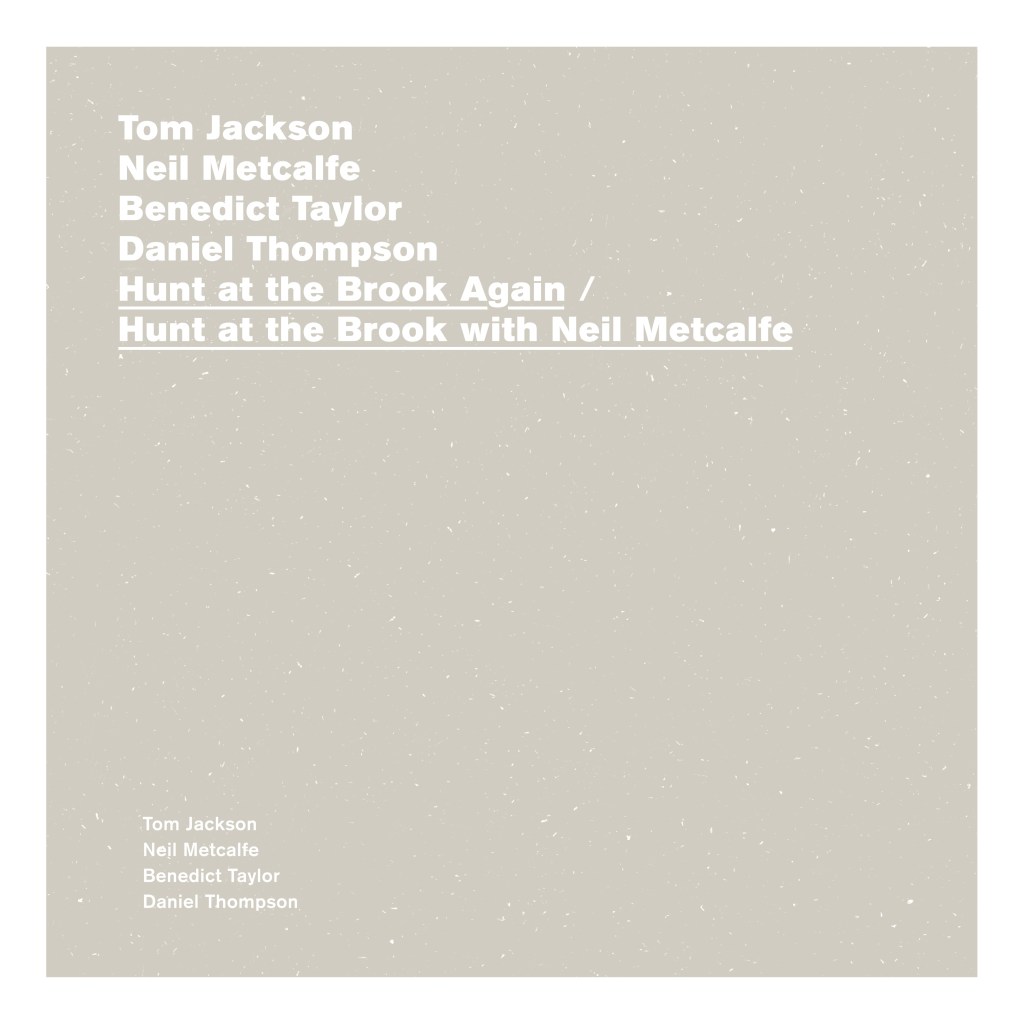
DAY ONE downstairs: 7pm: HUNT AT THE BROOK trio In 2014, Tom Jackson (clarinet), Benedict Taylor (viola) and Daniel Thompson (guitar) came together as a trio to record their debut in Stamford Brook with engineer Dave Hunt (hence Hunt at the Brook). Playing in the context of democratic free interaction, with accents and ideas reminiscent of Taylor and Jackson’s classic roots merging seamlessly with the free explorations of Thompson’s willful guitar playing. Their new album (a double disc, including guest musician Neil Metcalfe) is out on A New Wave Of Jazz.
9pm: JOHN EDWARDS/ANDREW LISLE/ DIRK SERRIES/COLIN WEBSTER quartet Dirk Serries (guitar), Colin Webster (alto saxophone), and Andrew Lisle (drums) are no strangers to each other having worked together prolifically for the last six years, most notably in Kodian Trio. In this quaret, the three are joined by one of the most pivotal figures in improvised music – John Edwards (double bass). Musically, the quartet play fully acoustic, and with Lisle playing a minimal percussion set-up. The stripped-back instrumentation allows for a focus on texture and timbre, but doesn’t prevent moments of ferociousness either, reminiscent of many albums from the formative ‘golden-era’ of improvised music, with the undeniable stamp of personality from these ‘modern- era’ musicians.
upstairs: 8pm: MARTINA VERHOEVEN & JOSÉ LENCASTRE duo A New Wave Of Jazz welcomes Portugese saxophonist José Lencastre to the family. Officially released during this festival is the newly formed LEMADI TRIO’s TRYPTOPHAN SUITE is the trio’s debut, an extraordinary live registration of José Lencastre (alto sax), Dirk Serries (guitar) and Martina Verhoeven on the electric piano. For this festival Martina and José are playing duo. Although here Martina on the upright piano but expect free improvised music that will be reminiscent of the trio and at same time not. Exciting.
DAY TWO downstairs: 4pm: TONUS (Andrew Lisle, Benedict Taylor, Colin Webster, Dirk Serries, Graham Dunning, Dominic Lash, José Lencastre, Martina Verhoeven, Matthew Grigg, Tom Ward) Dirk Serries’ minimal ensemble TONUS, frequently based upon his graphic scores, returns to HYG with an impressive and eccentric line-up, acoustic and electronic. Although the graphic scoring will guide the musicians gently, the strength of this ensemble is the focus and patience of each player to interact and contribute. Deep listening pur sang.
upstairs: 3pm: CHARLOTTE KEEFFE & ALAN WILKINSON duo Oh yes, a powerhouse duo guaranteed. Both musicians have been frequently involved with the label so both Alan as Charlotte couldn’t be left out. To start the 2nd day of the festival with panache, we invited them to play duo upstairs. Full on free impro (saxophone, bass clarinet, trumpet and flugelhorn) up close and personal.
MUSIQUE MACHINE reviewed VIDNA OBMANA’s DANTE TRILOGY 3xCD reissue on ZOHARUM and gave it a 5 out 5 rating ! Available here.
“Dante Trilogy is the next in the series of reissues of the albums from the important/ influential European ambient project Vidna Obmana by Poland’s Zoharum. As its title suggests it’s a three-album/ CD set- bringing together the following early 2000 albums- Tremor, Spore, and Legacy– all originally released by Release Entertainment, the Sub-label of Relapse Records for ambient, noise, and experimental works. The vibe over all three albums is decidedly darkly eastern & mysterious- with use of ethnic to eerily dissonating percussive elements.
The three discs come presented in an eight-panel fold digipak. This takes in on its back & front cover a moodily monochrome picture of what looks like a frost-touched strap over aged wood. With dull gold boxes featuring the various texts related to the three albums- as well as quotes from Dante’s inferno. It’s a simple, but very effective-looking package- which nicely enhances the feeling of dark timeliness running through all three of the albums featured here.
So first up we have Tremor– this was originally released in September of 2001. It features eleven tracks- which have runtimes between three and just over eight minutes. We move from “Mindtunnel” with its mix of stripped-back-but-eerily detailed ethnic percussion and broodingly waving flute-like tones. Onto steady-yet-ghostly drum battering rhythms meets the darkly swelling string-like ambience of the title track. Through to the soothing disorientation of “Descent” with its hazy layer-like shift- which hints at warble, shimmer, and scrape. The whole album really brought to my mind walking the shadowy corridors of an ancient pyramid- as leathery unseen snakes slither, nocturnal insect life scuttles, and maybe even the dead & wrapped human inhabitancy of the place decide to come back to life.
Disc number two takes in Spore– this was originally released in January 2003. It takes in nine tracks- with runtimes of three to seventeen minutes. We go dripping ‘n’ snapping percussion meets buzzing bass line of “Skin Strip” which is underfed by lightly gliding & shadowy ambient simmer. Onto the tight ‘n’ clipped electro pitter-patter meets drifting & warbling unease of “Creep- Isolation Trip”. Through to the gloomy bass ebbs and creepy guitar picking of the title track. This album feels less about forming a connected sonic picture, and more about creating separate snapshots of ambient unease, and subtle beat-bound atmospherics.
Finally, we of course have Legacy– this was first released in October of 2004. It’s made up of eight tracks- which have runtimes of between two and eight minutes. We move from the steady almost electro-rock-like drumbeats, shimmer & hazing ambient tones, and broodingly gliding bass lines of “Torment And Resolution”. Through to distant warbling horn unease, stripped back shuffling ‘n’ sliding percussion, and backwards tone disquiet of “The Virtual Insomnia”. Through to the gloomy unease and circling eerier disquieting of the title track- which blends together recycled bass guitar hover, and atmospheric guitar scaping. Of the three albums I’d say Legacy is the most sonically varied from track to track, we also get a few guests too like vocals from Steve Von Till on one track, and guitar from Steven Wilson on another track. As a whole, I’d say that Dante Trilogy features some of Vidna Obmana’s most approachable, at times darkly majestic work. So this would be a most excellent inroad/ introduction to the project’s discography. I can’t imagine this set has got a huge pressing- so I’d most certainly act sooner rather than later to get your hands on this set. Simply put another great addition to this reissue series, and three great early 2000s ambient-electronic albums. “
DARK ENTRIES REVIEW : “We hebben al verschillende heruitgaven van het werk van Vidna Obmana door het Poolse Zoharum besproken, en zolang ze blijven uitkomen, gaan wij verder op ons elan. Vidna Obmana is een buitengewoon productieve Belgische artiest die al sinds het midden van de jaren tachtig ambient maakt, en samengewerkt heeft met namen als Hybryds, Steve Roach, Serge Devadder, David Lee Myersen en PBK.
Tussen 1984 en 2007 bracht Vidna Obmana niet minder dan 87 uitgaves uit, om daarna onder zijn werkelijke naam Dirk Serries verder te gaan. Zoharum heeft ondertussen tien heruitgaves van Vidna Obmana op de teller staan, en daar moet u weten dat één heruitgave vaak twee of drie platen van Vidna Obmana bevat. Deze ‘Dante Trilogy’ bevat bijvoorbeeld drie platen die tussen 2001 en 2004 verschenen.
Bij zoveel overvloed aan ambient zou u kunnen denken dat het allemaal een beetje als hetzelfde klinkt, maar dat is hier uitdrukkelijk niet het geval. Waar de verschillende werken die we besproken hebben uit het einde van de jaren tachtig vooral elektronica en loops bevatten, wordt hier met een panoplie aan echte instrumenten gewerkt, en klinkt de muziek aanzienlijk minder repetitief.
U merkt aan de naam ‘Dante Trilogy’ dat de trilogie die hier voorgesteld wordt een thema heeft, en u kunt misschien wel raden dat het hier om het beroemde ‘Inferno’ van de Italiaanse middeleeuwse schrijver Dante Alighieri gaat. De beslissing om rond dit thema te werken nam Vidna Obmana blijkbaar omdat hij bij een nieuw label getekend had – Relapse Records / Release Entertainment – dat gespecialiseerd was in metal.
Nu weten we natuurlijk dat metalfans vaak interesse hebben in dark ambient, maar dan liefst als het echt donker en luguber is. De keuze voor de ‘Inferno’ van Dante als thema komt daar zeker aan tegemoet. Bovendien had Vidna Obmana het gevoel in een doodlopend straatje te zitten. Hij had hard gewerkt om zich een naam te maken in de ambientwereld, en wou nieuwe horizonten verkennen. Het bleek een heel goede zet te zijn, want zijn ‘Dante Trilogy’ werd effectief als baanbrekend beschouwd.
Eigenlijk maakt ‘Inferno’ ook deel uit van een trilogie van Dante Alighieri, die begon met de hel (Inferno), vervolgde met de louteringsberg (Purgatorio) en eindigde met de hemel (Paradiso). Vast staat dat Dante in ballingschap leefde toen hij zijn ‘Comedia’ schreef. Door een politiek conflict waarbij Dante behoorde tot een fractie die het onderspit delfde, moest hij van Florence naar Rome verkassen. U begrijpt dat Dante bijgevolg zijn politieke tegenstanders, waaronder de machtsbeluste paus Bonifatius VIII, in de hel plaatste.
Het beeld van de hel dat Dante creëert is zeer donker, met uitvoerige beschrijving van de aangepaste straffen voor verschillende soorten misdadigers. Volgens sommige critici was Dante zelf depressief en misschien zelfs suïcidaal toen hij zijn ‘Comedia’ schreef. ‘La Divinia Comedia’ – de meer uitvoerige titel die pas twee eeuwen na de dood van Dante werd gegeven aan zijn magnum opus – wordt hoe dan ook als een literair meesterwerk uit de middeleeuwen beschouwd.
Laten we teruggaan naar de muziek en de trilogie die nu in onze cd-speler draait. Het eerste deel van de trilogie heet ‘Tremor’ en kwam in september 2001 uit. Het was een stijlbreuk voor Vidna Obmana, die hier gebruik maakt van heel wat instrumenten: boventoonfluiten, fujara’s, elektrische gitaren en ebow harmonieën, allemaal bijgestaan door heel wat galm en atmosferische geluiden en door variërende tribale ritmes. Toegegeven, Serries had reeds eerder met deze elementen gewerkt, maar hier vormen ze echt de basis van de atmosferische klankvelden.
Op het tweede deel van de trilogie – ‘Spore’, dat in januari 2003 verscheen – grijpt Vidna Obmana deels terug naar typisch elektronisch gevormde ritmes, al blijft de nadruk wel liggen op galmende fluiten en andere geluiden. Belangrijk is dat Dirk Serries hier ook andere muzikanten uitnodigt om mee te spelen. Joris De Backer brengt contrabas en strijkers aan op twee nummers, en niemand minder dan Marc Verhaegen – in wiens versie van The Klinik Dirk Serries ooit gespeeld heeft – brengt wat trompet op het slotnummer.
Het derde deel ‘Legacy’ uit 2004 verrast door te starten met een stuk gesproken woord uit ‘Inferno’ door Steve Von Till van Neurosis. Uiteraard komen de meer zweverige elementen die we uit de vorige delen kennen snel aan bod. De samenwerkingen worden nog uitgebreider, en bevatten zelfs elektrische gitaar door Steven Wilson van Porcupine Tree, waar Serries verschillende keren mee samenwerkte. Vrouwlief Martina Verhoeven – die zoals steeds instaat voor de lay-out van de heruitgaven – deed ook een bijdrage met ‘gerecycleerde stemmen’.
Zonder enige twijfel is ‘Dante Trilogy’ een van de meest gevarieerde werken van Vidna Obmana. De vraag stelt zich zelfs of dit nog ambient is, iets wat Dirk Serries zelf ook in vraag gesteld heeft. Voor mij is het dat vast en zeker wel, ook al wijkt Vidna Obmana hier behoorlijk af van de platgetreden paden in het genre. Het vormt één geheel dat rustig en galmend voorbij kabbelt. Het resultaat is een zeer opmerkelijk werk dat bijzonder rijk is aan geluiden en atmosferen, wat mij net aanzet om deze uitgave – dat terecht de drie cd’s in één pakket bevat – sterk aan te bevelen.”
The fantastic FREE JAZZ WITH FRED, a radio show hosted by Fred Kellogg on KAOS 89.3FM (Olympia, Washington USA), has been supporting the label and related releases over the past years. The latest episode features our latest two releases and Dirk Serries’ IMPETUS GROUP album on Klanggalerie. Let yourself be accompanied by a few hours of fine radio-making. Listen here.
Courtesy of critic Georges Tonia Briquet, our latest 2 releases just got a review on the JAZZ’HALO website. Both albums are still available through our bandcamp store.
“Geen naam van een advocatenkantoor of niet de titel van een vergeten aflevering uit het repertoire van Monty Python deze ‘Zwosch, Zwosch & Zwosch’. Het betreft het triumviraat van Carlos “Zingaro” (viool), Guilherme Rodrigues (cello) en José Oliveira (percussie) dat de inspiratie haalde bij de Duitse dadaïstische collagekunstenaar en klankengoochelaar Kurt Schwitter. Deze drie improvisators “pur sang” uit de Portugese scene doen hem alle eer aan met de opname. Ze gebruiken wat percussie en geschuifel over snaren als introductie van dit concert dat plaatshad op 30 juli 2021 tijdens het Festival DME in Lissabon. Doodse stilte langs de kant van het publiek en een steeds complexer kluwen van akoestische klanken op het podium. Indrukwekkend hoe deze muzikanten met een minimum aan gereedschap een gelaagde en ingenieuze structuur opbouwen. Of hoe ze hedendaagse kamermuziek ogenschijnlijk nonchalant koppelen aan doorgedreven impro. Soms lijkt het of ze over elkaar heen struikelen maar elke beweging of uithaal geeft aanleiding tot een nieuwe gecalculeerde zet. Voor nadere kennismaking met het trio verwijzen we naar de hoestekst van Guy Peters. Van daaruit is het een kwestie om de interessante discografie van de drie uit te pluizen. Dit leidt tot connecties met onder meer Paul Lytton, Joëlle Léandre en Peter Kowald.” Jazz’Halo – Belgium
“Op het eerste luik van deze dubbel-cd (‘Hunt At The Brook Again’) treden Tom Jackson (klarinet), Benedict Taylor (altviool) en Daniel Thompson (akoestische gitaar) aan. Van bij de eerste noten wordt het bordje “actie” bovengehaald. Al even snel ruilen ze de actie echter in voor een omzichtige uitwisseling om nadien een nieuwe tempowissel in te lassen. Het trio blijft zo gedurende vijftig minuten stroomstoten aan elkaar rijgen. Snarengetokkel en intens gepluk vullen de even koortsachtige klarinettonen aan. Ze deinzen er niet voor terug om tot extremen te gaan zoals in ‘Second Movement’ (ongeveer na tien minuten) of aan het begin van ‘Fourth Improvisation’. In ‘Fifth Improvisation’ lijkt het zelfs of ze zich gaan “outen” als heuse rockers. Daar tegenover zijn er wat luchtigere en speelsere passages, meestal zelfs in hetzelfde “nummer”. Voor het tweede deel (‘Hunt At The Brook With Neil Metcalfe’, 46’10) kregen ze het gezelschap van fluitist Neil Metcalfe. Geen drie plus een maar een hecht kwartet dat duidelijk een gelijkgestemde visie heeft en maar al te graag musiceert aan de hand van berekende toevalligheden. Concreet betekent dit dat ze continu kiezen voor het verweven van bevreemdende richtingen en samenvoegingen. Korte stiltemomenten maken hier deel van uit. Bovenal overtreft de verbeelding het pragmatische.”
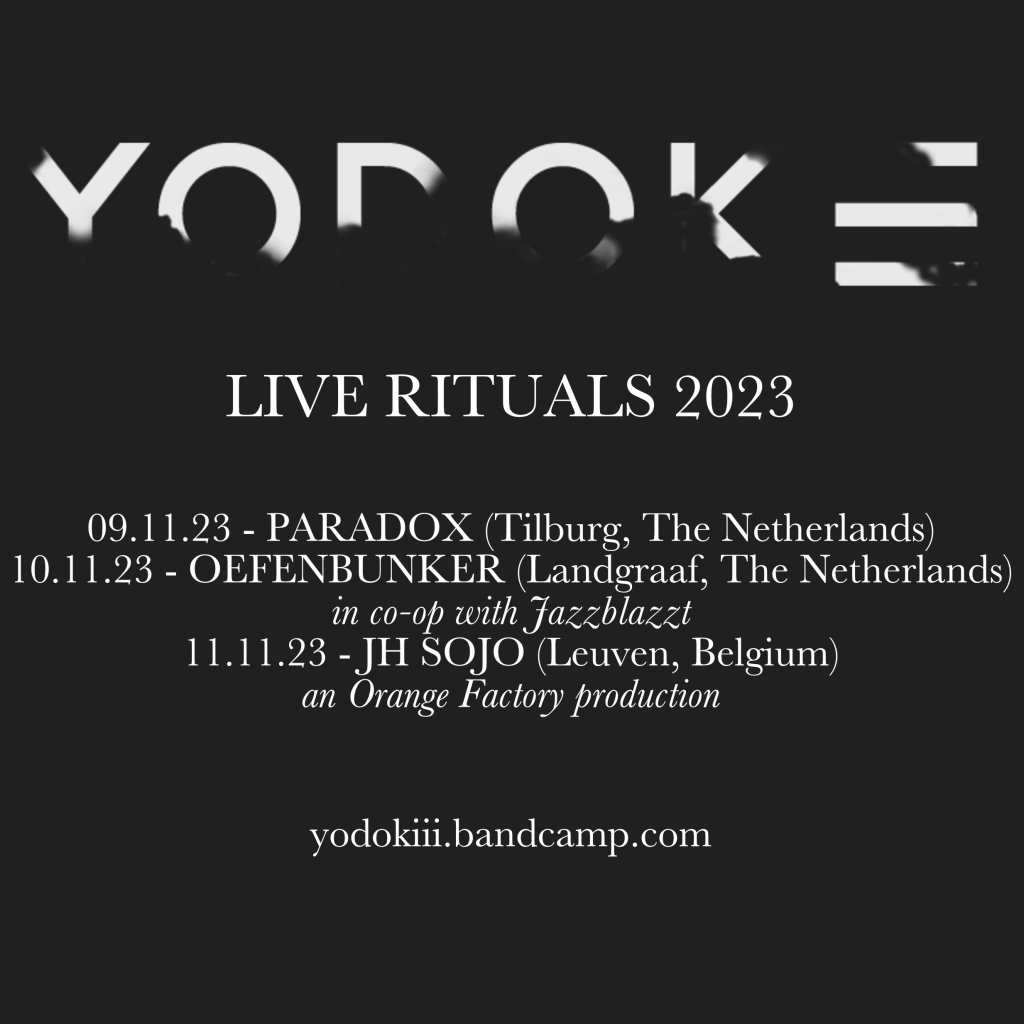
YODOK III, the super band around TOMAS JÄRMYR (drums), KRISTOFFER LO (tuba) and DIRK SERRIES (electric guitar), are playing the Lowlands this Thursday, Friday and Saturday. Since their debut gathering in Norway August 2012, YODOK III have established a huge live reputation for creating these incredible soundscapes balancing between post-rock, doom, ambient, drone and avant-garde. Performances are quite infrequent, due to the busy schedules of all 3 musicians, but now they are back with 3 new live concerts, playing Paradox (Tilburg, NL) on November 9th, November 10th at Oefenbunker (Landgraaf, NL) and JH Sojo (Leuven, B) on November 11th. Comes highly recommended.
YODOK III, the super band around TOMAS JÄRMYR (drums), KRISTOFFER LO (tuba) and DIRK SERRIES (electric guitar), are playing the Lowlands this Thursday, Friday and Saturday. Since their debut gathering in Norway August 2012, YODOK III have established a huge live reputation for creating these incredible soundscapes balancing between post-rock, doom, ambient, drone and avant-garde. Performances are quite infrequent, due to the busy schedules of all 3 musicians, but now they are back with 3 new live concerts, playing Paradox (Tilburg, NL) on November 9th, November 10th at Oefenbunker (Landgraaf, NL) and JH Sojo (Leuven, B) on November 11th. Comes highly recommended.
Nagranie kwietniowe, to trio złożone z klarnetu, gitary akustycznej i altówki, posadowionych w takiej kolejności, od lewej do prawej strony naszego spektrum odsłuchowego. Na zagranie sześciu improwizacji muzycy potrzebują ponad 50 minut.
Początek, to swoiste small talks zalotnego klarnetu, na poły śpiewnej altówki i minimalistycznej gitary, która cedzi strzępy akordów. Muzycy dość szybko lepią z tego dalece emocjonalną narrację, świetnie na siebie reagują. Druga opowieść zdaje się być odrobinę mroczna, z jednej strony tworzą ją minimalistyczne szumy i szelesty, z drugiej post-melodyjne westchnienia. Improwizacja z każdym krokiem nabiera jednak mocy, a prawdziwie urokliwą ognistość osiąga po 10 minucie. Ekspresja nabiera tu niemal rockowych barw, szczególnie na strunach altówki. Trzecią opowieść zagaja gitara, altówka trzeszczy w szwach, a klarnet snuje kameralne melodie. Artyści przypominają teraz trzy gołębie usadowione na kolczastym drucie. Najpierw skaczą, potem gasną w obłoku post-melodii i strzępów dźwięku. W czwartej części muzycy serwują nam emocje od pierwszej sekundy. Altówka i klarnet niemal krzyczą, gitara z kolei stawia stemple. Improwizacja faluje niczym wzburzony ocean, bywa, że nabiera post-romantycznego powietrza w płuca, bywa, że śle nam grad drobnych, preparowanych fonii. Początek piątej części jest definitywnie minimalistyczny. Bardziej żwawa narracja rozpoczyna się w momencie, gdy na gryfie altówki pojawia się plama brudu. Emocje rosną tu w postępie geometrycznym, ale gdy zajdzie taka potrzeba, droga od fire music do post-classic chamber trwać może ledwie kilka sekund. Ostatnia improwizacja wydaje się być niezwykle delikatna. Małe melodie i filigranowe szarpnięcia za struny budują tu jednak całkiem dynamiczną ekspozycję, niepozbawioną przybrudzonych, zadziornych fraz.
Hunt At The Brook with Neil Metcalfe
W maju muzycy spotykają się już we czwórkę, a instrumentarium zostaje uzupełnione o flet. Tym razem improwizacja składa się z czterech części i trwa niewiele ponad trzy kwadranse.
Pierwsza improwizacja rodzi się z ciszy, wstaje z kolan wyjątkowo powoli. Altówka skrzypi, reszta załogi podśpiewuje pod nosem. Niektóre wątki zdają się tu brzmieć niemal klasycznie. Szczęśliwie opowieść nabiera jednak rumieńców i zaczyna toczyć się w estetyce, którą tak sobie cenimy. Dobre akcje, świetne interakcje, zadziorne frazy, wyłupiaste spojrzenia i uszy otwarte na każdy dźwięk. Narracja po kilku wzniesieniach tonie w mroku minimalizmu, ale to zdaje się jeszcze bardziej podkreślać urodę chwili. Po restarcie emocje zaczynają buzować, a improwizacja mienić się wszystkimi kolorami tęczy. Finał kilkunastominutowej opowieści, to morze wyjątkowo udanych interakcji. Kolejną część zaczynają samotne dęciaki, płynące bardzo kameralnym strumieniem. Strunowce w rekontrze ślą cięte riposty polepione w brudne frazy. Niewiele tu trzeba, by cały kwartet zatonął w ekspresyjnej, jakże kolektywnej akcji, nasyconej wszakże silnie molową melodyką. Opowieść ma jeszcze jedno efektowne spiętrzenie, zainicjowane przez nad wyraz aktywnego w tym akurat momencie gitarzystę. Trzecia improwizacja, równie leniwa na starcie, jak ta pierwsza, zdaje się wstawać z grobu. Brzmi mrocznie niczym surowa muzyka dawna. Dęciaki w żałobnych modlitwach, strunowce w roli pająków tkających coraz większą pajęczynę. Zdaje się, że każdy, nawet najdrobniejszy dźwięk znajduje tu swoje miejsce. Po fazie dramaturgicznego rozwinięcia następuje piękna finalizacja, która płynie korytem melodii i smutku. Nagranie wieńczy czterominutowa koda, która zdaje się konsumować urodę wszystkich poprzednich epizodów. Wstęp gitary i fletu, rozwinięcie w pełni kolektywne. Zróżnicowana dynamika i dużo emocji na ostatniej prostej.” Spontaneous Music Tribune – Poland
“Portugalskie spotkanie miało miejsce w sercu lizbońskiego lata roku 2021. Kameralne, strunowe (skrzypce i wiolonczela), ale pełne zaskakujących emocji, szczególnie dzięki bardzo aktywnej pracy perkusjonalisty, który nie stronił od rytmicznych, niekiedy całkiem dynamicznych akcji. Dodajmy, iż koncert jest nieprzerwanym strumieniem dźwiękowym.
Już od startu perkusjonalista silnie akcentuje swoją obecność – zdaje się mieć w ręku mnóstwo przedmiotów, które jednocześnie wydają dźwięki, choćby miseczki wypełnione metalowymi kulkami. Wiolonczela budzi się do życia ze śpiewem na ustach, z kolei skrzypce naciągają wyjątkowo suche struny. Trochę akcji mechanicznych, garść rezonujących fraz i incydentalnie preparowane frazy ze strony każdego z muzyków. Perkusjonalista w tę różnorodną i wielogatunkową improwizację wkłada mnóstwo kreatywności, którą usytuować można w nieskończonych doświadczeniach free improv, z kolei skrzypek i wiolonczelista uzupełniają ów gatunkowy tygiel mnóstwem fraz post-barokowych, ale niekiedy wręcz bogactwem godnym renesansu. Narracja ma tu wiele faz, urokliwe skrzy się gęstymi porcjami ekspresji, innym razem chowa w ciszy i zdaje się wtedy produkować jeszcze piękniejsze frazy. Dużo mamy melodii, ale także zaskakujących sytuacji, gdy nagle wszystkie instrumenty brzmią niczym wataha dzikich perkusjonalii. Po 20 minucie napotykamy na szczególnie fascynujące wydarzenia – najpierw skrzypek i wiolonczelista siłują się ze strunowymi naciągami, a towarzyszy im nerwowy, szeleszczący perkusjonalista. Potem następuje skok w estetykę muzyki dawnej, bogaconej sekwencja gongów. Gdy cello niespodziewanie przechodzi w tryb pizzicato, improwizacja zaczyna nowe życie, przez moment stając się teatrem jednego aktora. Tuż potem, już w niedalekiej bliskości zakończenia, dostajemy porcję wyjątkowo pięknych, strunowych śpiewów, które doposaża w emocje niecierpliwy i znów niezwykle kreatywny perkusjonalista. Ta niebywała, choć jakże krótka podróż zwieńczona zostaje wspólnym, szczęśliwym dronowaniem.” Spontaneous Music Tribune – Poland
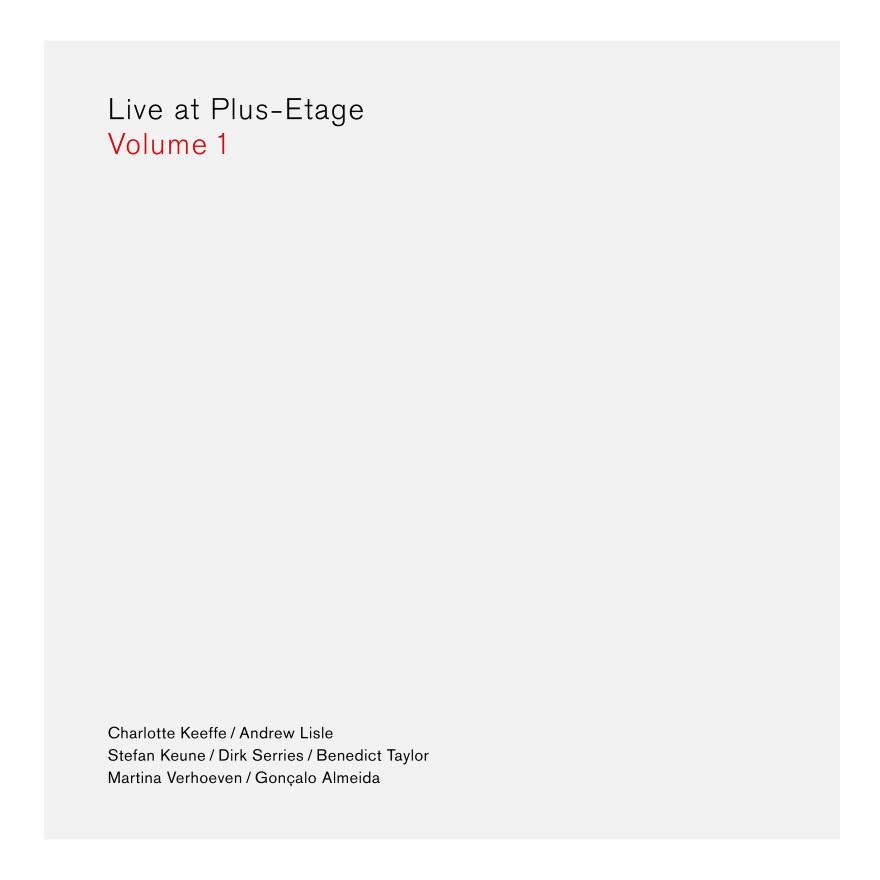
On his ORYNX-IMPROV’ANDSOUNDS blog Jean-Michel just shined his light on our 3CD live compilation LIVE AT PLUS-ETAGE, VOL 1. This triple album is available here.
“Un Plus Etage dans une petite ville qui n’est ni entièrement néerlandaise, ni entièrement belge, bien que située au nord de la frontière belgo – néerlandaise. Baarle-Hertog et Baarle-Nassau. Enclaves incluant des Exclaves qui contiennent parfois des Enclaves parmi lesquelles le résident belge a son jardin contigu aux Pays Bas. Et l’aubergiste sert ses clients dans les deux pays : la frontière est délimitée par des traits de peinture à même le sol de la salle séparant les tables installées soit aux Pays-Bas, soit en Belgique. Peut-être que l’Étage mentionné est apatride… Charlotte Keefe est une trompettiste inspirée de la scène Britannique qui s’est fait entendre et enregistrer depuis plusieurs années. Andrew Lisle est un fidèle d’Alex Ward, Dan Thompson, Colin Webster etc… En se servant de son solide bagage de batteur de jazz, Andrew Lisle insuffle une trame vivante et musicale à des enchaînements – tuilages de figures de batterie, de frappes variées sur les fûts et le bord de sa caisse claire, des vibrations sonores en rythmes libres, pulsations rebondissantes. Charlotte Keefe zigzague au travers de fragments de mélodies, sussurrations, déchirures du timbre, écrasements de notes, effets de souffle et de pistons, vocalisations : un langage et une grammaire free face au drumming de son compagnon, à mi-chemin entre le dialogue et une fonction de support polyrythmique. Une approche plus structurée et différente des percussionnistes pointus de la libre improvisation : les Paul Lovens, Paul Lytton ou Roger Turner ou John Stevens avec son kit réduit du S.M.E. Saluons le timing, la précision et la cohérence de sa prestation et la foison de figures pulsatoires déclinées ici tout au long d’une prestation de 50 minutes qui tient la route. Présence inspirante pour Charlotte Keefe, toute entière à explorer son instrument dans l’orbite du feeling rythmique instillé par le batteur. Je ne sais pas s’il s’agit d’un duo fixe ou d’une association ad-hoc dans le cadre de tournées respectives des sept musiciens enregistrés lors de ce concert du 29 Avril 2022. De toute façon, ce sont d’excellents musiciens et des improvisateurs émérites qui assurent une belle performance. Stefan Keune. Alors, un message pour les fanatiques de feu Peter Brötzmann, de Mats Gustasson ou d’ Evan Parker, voici un sérieux client qui a mis un temps infini à s’imposer un (tout petit peu). Lors d’une interview d’Evan Parker au sujet des collègues plus jeunes dont il se sent proche esthétiquement, celui-ci n’a pas hésité à citer Stefan Keune en premier lieu, Stefan jouant alors régulièrement avec son ami, le guitariste John Russell (cfr Frequency and Use / Nur Nicht Nur). Le trio du CD2 a une instrumentation similaire sax guitare violon à celle du trio de Russell avec Phil Durrant et John Butcher, autre saxophoniste proche de Parker. À l’alto, le britannique Benedict Taylor, un collaborateur régulier du belge Dirk Serries, le troisième homme du groupe et responsable du label a new wave of jazz. Stefan Keune nous fait l’honneur de jouer ici exclusivement du sax sopranino, un instrument malaisé à manipuler, surtout si un quidam saxophoniste voudrait réitérer les exploits sonores de cet improvisateur germanique exceptionnel. Son articulation en double et triple détachés, déchiquetant le timbre et la texture normale de son biniou « jouet » , des extrêmes aigus quasi inatteignables grâce à la magie des harmoniques qui sifflent et tintent au-delà du registre le plus élevé. Confiez un sax sopranino à un saxophoniste professionnel (même diplômé du Conservatoire) pour en jouer au pied levé, la grande majorité d’entre eux vont décliner l’offre. Cet instrument requiert un entraînement spécifique pour en contrôler le souffle avec de nombreux intervalles de clés différents, son intensité, sa justesse, sa fluidité et la capacité dynamique entre le pianissimo le plus doux jusqu’au forte le plus puissant. Bonne chance ! Parmi les élus, Anthony Braxton, feu Wolfgang Fuchs et Lol Coxhill, Michel Doneda et mon copain Jean-Jacques Duerinckx. À ses côtés, l’altiste Benedict Taylor, le phénomène des gammes microtonales en glissando inspirées des violonistes de Raga d’Inde du Nord à la projection sonore impressionnante, sculpte la vibration boisée de l’âme de l’alto (un instrument plus difficile à maîtriser) avec une attaque audacieuse de l’archet sous tous les angles et une variation maniaque dans l’intensité de la pression des notes sur la touche ou dans les frôlements à peine audibles… Un des excellents violoneux de l’improvisation qui comptent dans l’univers de l’improvisation en Grande-Bretagne. Avec ces deux lascars intrépides, rien de tel que la gratte bruissante munie du sacro-saint chevalet qui fait résonner et trembler les cordes raclées, grattées, frictionnées avec autant de circonspection que d’énergie par Dirk Serries. Acoustique, bien sûr. On navigue ici dans les eaux pointillistes, l’abstraction formelle, les techniques alternatives qui transforment et altèrent définitivement l’instrument, ses conventions et ce pourquoi il a été conçu. « English disease », improvisation libre radicale British des John Stevens, Derek Bailey, Evan Parker, Paul Rutherford, Phil Wachsmann, John Russell, Roger Smith etc…. Une véritable dérive dans un paysage sonore imprévisible, exploratoire de sonorités improbables, de flux explosés, découpés par des zones de silence qui font partie intégrante de la musique. Par comparaison, le duo précédent de Keefe & Lisle semble avouer une relative fidélité au jazz moderne. Avec la pianiste belge Martina Verhoeven et le contrebassiste Gonçalo Almeida, on revient un peu sur terre au CD2. Vous imaginez un piano, l’instrument bourgeois de la musique classique et ses 88 touches en tons et demi-tons sur les douze notes de la gamme tempérée, devoir s’intégrer dans la foire d’empoigne du trio Keune Taylor Serries ? Mais nos deux artistes nous avaient préparé une belle surprise en duo de contrebasses avec un départ minimaliste, relativement répétitif, sons ténus, frottements éthérés de la contrebasse, sciages , pizzicatos. Ambiance mystérieuse, graves bourdonnants, glissandi vers le soubassement des cordes, vibrations boisées grinçantes, frappes de l’archet, aigus flûtés ou nasillards au bord du chevalet. Et petit à petit s’imposent les contrastes débridés, les changements abrupts de registres, de tessitures, approfondissant le mystère et la frénésie ludique. Voilà une démarche appropriée pour que la musique de ce troisième set sonne aux antipodes des musiques des CD 1 et 2 et offre une toute autre esthétique, même si la performance est parfois un peu longue (qui n’essaie rien n’aura jamais rien). Elle rebondit aussi avec une belle énergie Vous n’imaginez pas conserver l’intérêt et l’attention du public durant deux heures et demie si la musique reste dans un statu quo esthétique et sonore. Un excellent témoignage d’une manière subtile de réussir un concert d’un soir, un partage éphémère d’instants merveilleux.
Ce qui est extraordinaire : les trois albums de cette chronique contiennent la participation inspirée de trois “altistes” ou “violonistes” alto ….” Orynx-Improv’AndSounds – Belgium
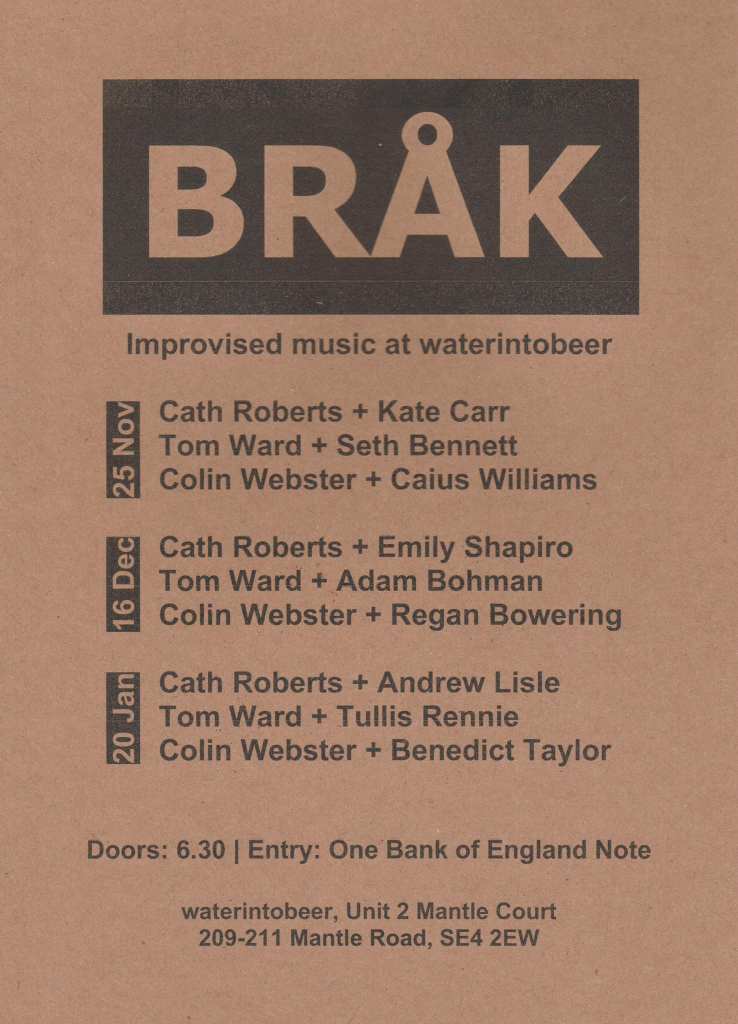
The BRÅK concerts, curated by TOM WARD, CATH ROBERTS and COLIN WEBSTER, are back with a new season, featuring lot of greats, associated with our label. This intimate events are taken place at this specialized beer shop in Brockley/South East London. Go and support them if you’re in the neighboorhood.