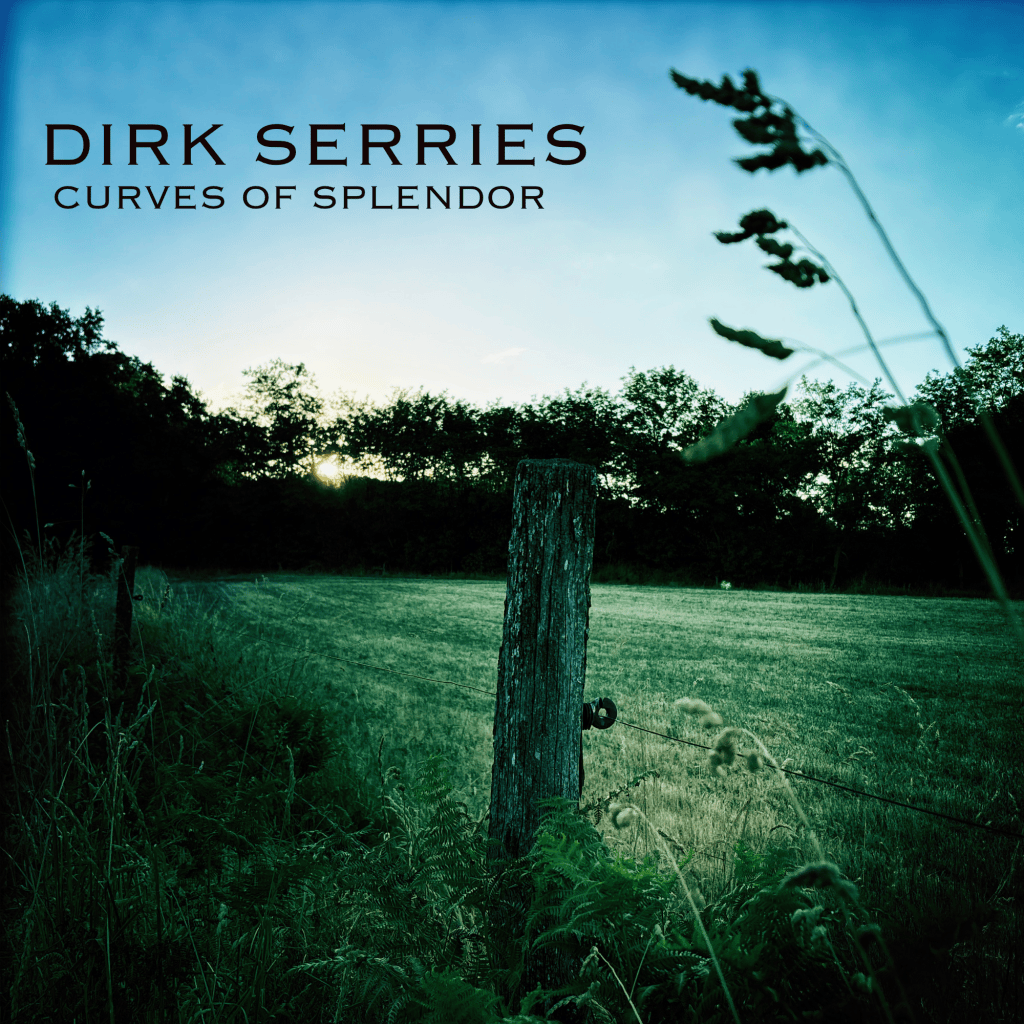
OUT NOW ON PROJEKT RECORDS :
DIRK SERRIES – CURVES OF SPLENDOR
Currently available at ‘name your price’ over at PROJEKT DIGITAL :
projektrecords.bandcamp.com/album/curves-of-splendor
With an electric guitar and a handful of effects, Belgian Dirk Serries (acclaimed for the work under his alter ego vidnaObmana) sculpts four gleaming long-form ambient tracks which embrace splendor with an optimistic light. Four mantras, infused with brightness, warmth and calmness, venturing to another place, another time, another dimension.
From the melancholic opening track ‘Destination Rewind’ to the trance-inducing longform end piece ‘Oblivion Serenade’, the music embraces a gentle complexity. Curves of Splendor, Dirk’s 5th solo album for Projekt, sees the grandeur of his processed guitar harmonics move playfully across a minimalist tranquility drenched in hopeful moods. The multiple overlapping guitar tones and waves generate a flow that elevates and transports the listener to a place of comfort, away from the intrusive world we live in today.
CHAIN D.L.K. REVIEW :
“Curves of Splendor” sounds like the sort of title that might come with its own incense, a photograph of a mountain nobody has actually climbed and instructions to breathe deeply while pretending not to think about the electricity bill. Dirk Serries, fortunately, is too experienced a musician to reduce serenity to lifestyle decoration. On “Curves of Splendor”, his fifth solo release for Projekt, tranquillity is not presented as an escape hatch but as something constructed patiently, tone by tone, from the unstable physical properties of an electric guitar and a handful of effects.
Serries has spent more than four decades testing what a limited vocabulary can actually contain. Beginning in the experimental underground of the 1980s and developing the celebrated Vidna Obmana project into one of the better-known names in European ambient music, he eventually abandoned that moniker in 2007. His later work under his own name, including the “Streams of Consciousness” series, has increasingly concentrated on the guitar as a source of sustained harmonic movement. Rather than treating the instrument as a vehicle for riffs, solos or conventional melody, Serries uses it almost as a generating surface, allowing tones to overlap, reinforce one another and gradually acquire different emotional weights.
That approach is immediately apparent in “Destination Rewind”. The title implies movement backwards, but the music refuses anything so efficient as actual time travel. A low, melancholy resonance establishes itself and then seems to inspect its own surroundings. Additional tones appear without announcing themselves as events, subtly modifying the harmonic temperature. The piece does not progress by accumulating conventional musical information. Instead, its changes are perceptual: a tone that initially seems distant becomes suddenly intimate; a stable chord reveals a faint internal agitation; what appeared to be a background layer turns out to have been doing most of the emotional work all along.
There is considerable discipline in this apparent simplicity. Anyone can sustain a guitar note. Doing so for twelve minutes while keeping the listener aware of minute changes in colour is another matter. Serries understands that repetition becomes interesting when the ear is given a reason to keep checking whether anything has changed. The answer is usually yes, although sometimes the change is so slight that the listener feels almost complicit in discovering it.
“Slowly Wired” is more obviously concerned with the electrical character of the instrument. Its harmonics gather in overlapping strata, producing a sensation of motion without requiring a beat. The title is almost comically accurate: the guitar seems to be connected to some enormous circuit whose voltage has been turned down sufficiently for us to hear the wiring rather than the fireworks. Serries’ effects do not decorate the guitar from the outside. They alter its identity, allowing a recognisable instrument to become a collection of resonances whose origin remains just visible enough to keep the music tactile.
This is an important distinction in an era when ambient music can too easily become indistinguishable from a beautifully photographed productivity app. “Curves of Splendor” has warmth, but it does not confuse warmth with blandness. Its harmonic language contains small frictions and ambiguities, and the brighter passages retain enough density to avoid becoming sonic wallpaper. The optimism in the record is therefore more convincing because it has not been achieved by simply deleting every darker shade.
The twelve-minute “A Curve of Splendor” develops that idea with particular patience. Its layers seem to bend around one another rather than move toward a destination, creating a sensation of continuous curvature. There is no dramatic arrival because the point is not arrival. Serries is interested in what happens when a sound remains present long enough for its physical character to become perceptible. Harmonics shimmer, tones thicken and recede, and the boundaries between foreground and background become pleasantly unreliable.
This is where the album’s title starts to make more sense. The “curves” are not merely melodic or spatial. They describe the way the music changes without breaking its continuity. A chord can brighten without becoming a new chord; a drone can acquire tension without turning into a climax; a familiar interval can suddenly seem larger because the surrounding frequencies have shifted. Serries makes these almost microscopic adjustments carry the expressive burden normally assigned to melody, rhythm and dramatic structure.
Then comes “Oblivion Serenade”, occupying more than half an hour and effectively changing the scale of the entire album. Thirty-three minutes is enough time for the listener’s usual impatience to begin making administrative inquiries, but the piece has little interest in satisfying it. Instead, it establishes a broad field in which harmonic layers slowly alter their relationships. The effect is hypnotic without relying on the blunt repetition of a conventional loop. One begins listening less for “what happens next” and more for the exact character of what is already happening.
There is something almost old-fashioned about this kind of attention. Serries asks for the listener to stay with a sound rather than consume a sequence of developments. That makes “Curves of Splendor” surprisingly resistant to background listening, despite belonging to a genre that is frequently recruited for precisely that purpose. It can certainly accompany quiet activities, but its subtleties reward a more concentrated ear. The longer one remains inside the piece, the more its apparently uniform surface starts to reveal differences in density, pitch and resonance.
The album also makes an interesting companion to Serries’ earlier ambient history without functioning as a nostalgia exercise. His vidnaObmana work was strongly associated with synthesizers and elaborate electronic environments, whereas his contemporary ambient practice places the electric guitar at the centre of the process. The instrument gives the music a certain organic irregularity. Even when heavily processed, its harmonics retain traces of touch, pressure and physical vibration. The electronics do not erase the guitar’s body so much as stretch it beyond its usual proportions.
That may be why the record’s serenity never feels entirely weightless. Beneath the smooth surfaces there is always evidence of something being played, manipulated and listened to in real time. The music has patience because the musician has developed a remarkably detailed understanding of how little needs to be changed for a texture to become newly expressive.
“Curves of Splendor” is therefore less a collection of four ambient compositions than an extended study in controlled continuity. Its achievement lies in making duration itself expressive without turning slowness into a virtue merely because it is slowness. The four pieces occupy a narrow territory, but Serries knows that narrow territories can contain plenty of weather.
And perhaps that is the album’s most useful form of optimism. It does not promise transcendence, enlightenment or any of the other expensive nouns routinely attached to ambient music. It simply demonstrates that attention can still make small things seem substantial: one harmonic overtone, one change in density, one tone arriving slightly later than expected. In a culture that keeps mistaking acceleration for progress, Serries offers something almost radical by comparison: music that has nowhere urgent to be, and consequently has time to notice what is happening.
“Curves of Splendor” does not demand that the world disappear. It merely makes it quieter for a while, which, given the current state of the species, is already a fairly respectable achievement.

