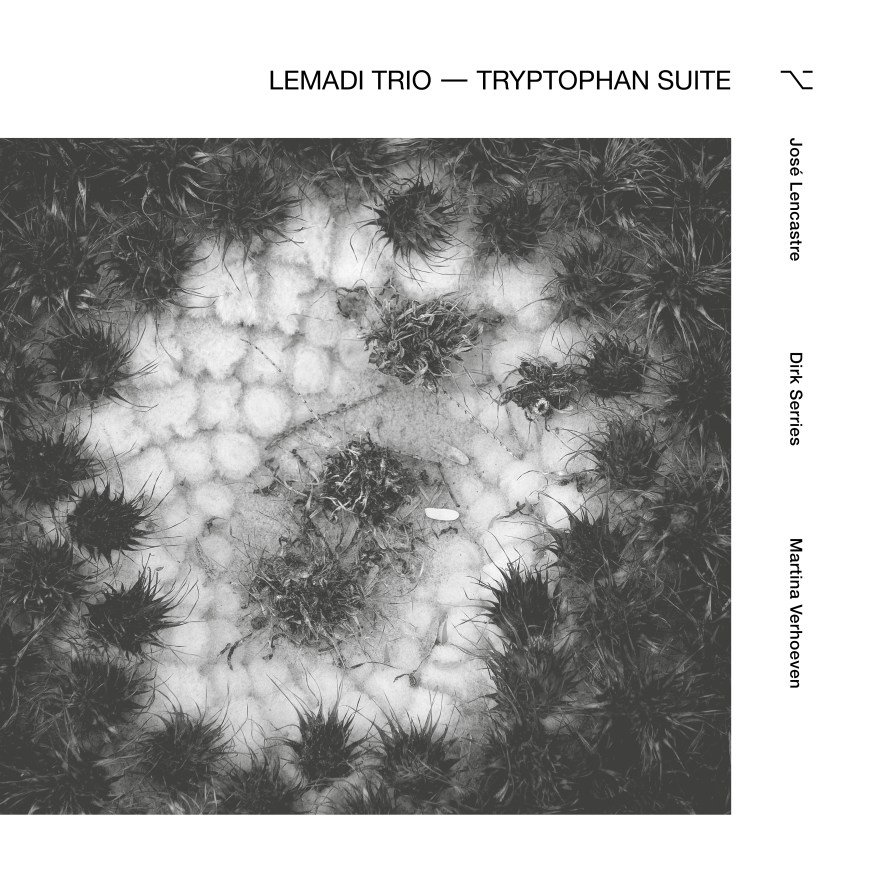
The excellent reviewer EYAL HAREUVENI just wrote a nice review for SALT PEANUTS (also read his excellent reviews on related albums like RODRIGO AMADO/ANDREW LISLE/DIRK SERRIES’ THE INVISIBLE and HUGO COSTA/FRISO VAN WIJCK/DIRK SERRIES’ Live At Oude Klooster Kapel) on LEMADI TRIO’s TRYPTOPHAN SUITE. The release is available through our bandcamp store here.
“The newly founded Lemadi Trio features another Portuguese sax hero José Lencastre (aon alto sax), Serries’ partner in life and music, Martina Verhoeven, on the vintage electric Crumar piano and Dirk Serries. Verhoeven alsto took the cover photo. This trio’s debut album was recorded live in May 2023 at Jazzblazzt in Neeritter, The Netherlands. It represents the very first notes this new trio played together, when «stars were aligned and the music flowed effortlessly in a profound conversation where each personality and instrument matters». Serries produced before a recording of Lencastre with fellow Portuguese musicians – electronics player Carla Santana, violinist Maria do Mar and double bass player Gonçalo Almeida (Defiant Illusion, A New Wave of Jazz, 2024). A week later after recording Trytophan Suite, Seriies and Lencastre they recorded a duo album, Live At Hotelier Porto Portugal May 7th 2023 (Nachtstück, 2023). The title of the album refers to an amino acid needed for normal growth in infants and corresponds faithfully with the natural development of the two, untitled and mostly sparse free improvisations. Lencastre alternates between short and brief attacks and whispering soft sounds with commanding, extended breathing techniques; Serries punctuates his flights with fast and sharp comments while Verhoeven floats gently in between with her highly resonating keyboard. Together they sketch these pieces like exquisite and unpredictable stories that occasionally gravitate towards dense and powerful climaxes.” Salt Peanuts – Norway
Ken Waxman of JAZZ WORD is catching up with some of the latest of our releases with a lovely review of DANDELION, the 2022 album of TOM JACKSON/KRIS VANDERSTRAETEN/DIRK SERRIES. The album is still available from our bandcamp store.
“Tom’s contribution may have been understated on the other disc, but during the Dandelion’s session Vanderstraeten is upfront most of the rime. Jackson’s shrills and tongue flutters set up the expositions with Serries metallic echoes, intermediate slides and up-the-neck picks and below-the-bridge clanks providing sympathetic decorations. Expanding both linear motion and auditory enhancements, the percussionist’s parallel, but not overwhelming cadences include hollow pops, woody crunches, Mylar scrubs, strained cymbal coloration and idiophone ratchets and shakes. Most prominent on “Violet blue” and “Dark green”, his playing creates the proper equivalence to the sounds from the other trio members. Jackson’s initially unaccompanied thin flutters are given extra gravitas by Vanderstraeten’s bolo-bat-like thumps and regularized tick tocks. While Serries’ string rubs, that can sound like stick friction bursting into flame, become even more taunt when framed by constant percussion sounds. Combing guitar ratchets and pops, high-pitched reed trills and cymbal smashes into group story-telling, the trio members continue to express individual textures as the narratives slide to a polyphonic conclusion, Without lacking any sonic elements, cooperative and cooperating trios like these can provide all the textures needed for enticing creative improvisations.” Jazz Word – Canada
Some exciting label-related news. One of our frequent and main partipants and kindred spirits saxophonist COLIN WEBSTER has since three years his large ensemble. Up till now they did two concerts, both at Cafe Oto in London (UK) and the 2nd one ‘SECOND EDITION” is now ready to be released on RAW TONK RECORDS. Pre-order it here.
The large ensemble was for this 2nd album : Colin Webster – alto sax Rachel Musson – tenor sax Cath Roberts – baritone sax Charlotte Keeffe – trumpet / flugelhorn Graham Dunning – electronics Dirk Serries – guitar Caius Williams – bass Andrew Lisle – drums
THE VOID OF EXPANSION’s 3rd studio album departs gently from its predecessor GOVERNED BY DECAY with a more direct approach to building up the guitar soundscapes and the interaction with the majestic and versatile drumming of Tomas Järmyr. Still very expansive but the 4 pieces are significantly their own while being part of the realm VOID has been created over these past 10 years.
SPONTANEOUS MUSIC TRIBUNE REVIEW “Album otwierają delikatnie szeleszczące talerze. Z gitary zaczyna sączyć się spokojny, ale szorstki w brzmieniu płyn ambientu, który już po kilku pętlach wydaje się płynąć przynajmniej dwoma, jeśli nie trzema strumieniami. Jeden z nich ma masę basową i okazjonalnie snuje się po podłodze. W tle słyszymy jedynie szmer szczoteczek. Wraz z leniwie upływającym czasem gitara zaczyna piąć się ku górze, a perkusja rysować bardziej wyrazisty, drummingowy flow. Całość nie jest jeszcze masywna, ani nawet głośna, ale niespodziewana zmiana dokonuje się tu niemal w ułamku sekundy. Już bowiem po upływie dziesiątej minuty muzycy stają w obliczu efektownej, gitarowej ściany dźwięku i gęstej pajęczyny perkusji. Opowieść gaśnie prawie dwie minuty, choć sama perkusjanie chce się z tym faktem długo pogodzić. Drugą historię otwiera melodyjna, matowo brzmiąca gitara. Najpierw oddycha i charczy, potem szybko formuje się w strugę groźnych fonii. Perkusista dość długo pracuje tu na basowo brzmiących tomach i w ogóle nie zbliża się do metalowych przedmiotów swojego full drumset. Narracja wydaje się być silnie rozkołysana i nabiera mocy z każdą pętlą. Wzorem pierwszego utworu, w połowie nagrania perkusista zaczyna zagęszczać flow, ale nie forsuje tempa. Sygnał do wzmożenia aktywności daje tu gitarzysta, frazując w coraz wyższych rejestrach. Opowieść z miejsca nabiera demonicznego, niezwykle mrocznego posmaku. Ta historia gaśnie przez kilkadziesiąt sekund przy wtórze umierającego dronu gitary. Trzecią opowieść na starcie wypełnia bezbarwna cisza. Docierają do nas niemal pojedyncze frazy percussion i drobne smugi kurzu z gitarowego gryfu. Szmery nasilają się przed upływem pierwszej minuty, a zaraz potem rodzi się plama gitarowego, czysto tu brzmiącego ambientu. Coś na kształt linearnej narracji pojawia się jednak dopiero po upływie piątej minuty. Ledwie co uformowany szyk, potrzebuje jeszcze kolejnych dwóch minut, by wejść na drogę bardziej gęstego, zwartego opowiadania. Oto bowiem wtedy gitarzysta zaczyna coś intensywnie budować, nakładać warstwę na warstwie. Jego instrument charczy, skowycze, boleśnie śpiewa. Perkusista dokłada masywne uderzenia, które powodują, iż narracja osiąga stan prawdziwie demonicznej histerii. Flow cały czas narasta, zdaje się przybierać prawdziwie czarne barwy. Perkusista nie tyle tu bębni, co biczuje werbel i tomy swojego zestawu. Na ostatniej prostej łapie punkowy 2-step, po czym cała opowieść ginie niespodziewaną, nagłą śmiercią. Po takiej wolcie czwarta odsłona Escaper nie może nie zacząć się wyjątkowo delikatnie. Ledwie słyszalne frazy gitary przypominają tu pierwsze promienie słońca po wielodniowej nocy polarnej. Matowa melodia ledwie szeleści, z czasem dochodzi do niej pasmo bardziej szorstkiego ambientu tworząc z pasmem prymarnym ciekawy dysonans intensywności. Pierwsze dźwięki perkusji docierają do nas po wielu minutach. Z czasem opowieść zdecydowanie nabiera mroku – gitara pnie się na szczyt, delikatnie falując, perkusja zaczyna rytualny taniec. Pod koniec gitara brzmi jak gruźlik w zaawanasowanym stadium choroby, tymczasem drumming nagle zamiera, zamieniając się w swobodny potok szumiących szczoteczek i matowo brzmiących talerzy.”
MOORS MAGAZINE REVIEW “The Void Of Expansion is een duo bestaande uit de Belgische gitarist Dirk Serries en de Noorse drummer Tomas Järmyr. Escaper is hun derde album in tien jaar, en ze knopen er meteen een tournee aan vast door België, Polen, Duitsland en Noorwegen – de moeite waard om te gaan kijken, want wat je hier hoort is live opgenomen, dus je kunt iets spectaculairs verwachten. Drummer Tomas Jarmyr (bekend van ZU, Motorpsyco etc) is de perfecte drummer om de magistrale soundscapes die Dirk Serries met zijn elektrische gitaar weet op te roepen nog meer kracht te geven. Ik laat je hier een paar fragmenten horen uit de vier stukken uit dit album, wat soms een vertekenend beeld geeft, want het denderende slot van Draught, daar hebben ze wel veertien minuten naartoe gewerkt! Hoe dat opbouwen gaat kun je dan weer mooi horen in het begin van Vessel. Weidse verten, magistrale horizonnen, je kunt het allemaal horen als je met dit duo meegaat op hun avontuurlijke muzikale reis. Een prachtplaat!”
VITAL WEEKLY REVIEW “In a sort of middle ground between the Serries solo CD and the Kodian Trio is the music of his duo with Tomas Järmyr on drums and Serries on guitar, which goes by the name of The Void Of Expansion; I had not heard of them before. This, too, is easily labelled as improvised music, and yet it’s nothing like Serries displays on his New Wave Of Jazz releases. Over there, he’s more acoustic and, above all, without the use of effects. In this duo, one track per LP side, there are a lot of effects and whatever chaos could ensue, they control it very well. The guitar feeding into effects creates an altogether different set of sounds, way more atmospheric than in many of his recent work with others, and yet also wilder than on the solo CD I just heard. Somehow, one could link this kind of free music, with a heavy dose of treated guitar sounds, to the world in which the word ambient combines with doom, metal or such things without putting up this wall of doomy metal music. In that respect, the music is way more atmospheric and can be enjoyed as four pieces of ambient music meet improvised music. Järmyr’s playing is rather loose yet heavily controlled, playing lots of small drum parts in a steady roll of these. Everything goes at a majestic slow speed, with every aspect of the sound picture in full use. Every piece has quite a similar building; Serries starts on the guitar with a few sounds and then adds a few more, then some more effects and Järmyr comes in in a similar way on the drums, less the effects. It’s a curious mixture of interests here and not something I can easily link to something else, which I guess is good (or shows my ignorance, whatever you prefer there), but improvised ambient is not something I have heard a lot about. “
AMN REVIEW : “Escaper is an album that lives up to – if not exceeds – the listener’s expectations from reading the liner notes. A live-in-the-studio duo recording from Dirk Serries on electric guitar and Tomas Järmyr on drums, it nods toward both ambient music and free improv without falling strictly into either camp. Serries creates roughly-textured waves of sound with his electric, using an array of effects that add color to ever-changing musical structures. Occasionally these sustained notes resemble that of a synthesizer, but he shifts their pitch and character too frequently to be categorized strictly as drones. Järmyr is a joy on this recording, contributing energetic and elaborate patterns of percussion. While heavily using the snare and cymbals, he gives the entire kit a workout, effectively soloing continuously throughout each of the four, long tracks. Toward the end of the album he adopts a few rock-oriented beats, but most of his playing is outside. The end result of this pairing is a gritty yet thoughtful album with long passages of dense but vigorous-created soundscapes. In a sense, Serries and Järmyr have reversed the traditional roles of their instruments, with the guitar creating a harmonic (almost rhythmic) base and drums in the lead. Regardless, there is a lot to like on Escaper, whether listening passively or actively.
KRAUTNICK REVIEW : “Was für Musik macht man mit lediglich Schlagzeug und Gitarre? Fun-Punk oder Indierock? Oder – Ambient? Für letzteres entscheidet sich das Belgisch-Schwedische Duo The Void Of Expansion, indem die Gitarre flächige Drones absondert und das Schlagzeug dazu ungezügelt herumgaloppiert. Da steckt natürlich eine Menge Jazz drin, und wer die improvisierten Kunstwerke von Jörg A. Schneider verehrt, ist bei „Escaper“ ebenso sehr gut aufgehoben, dem vierten gemeinsamen Album des Duos, bestehend aus Gitarrist Dirk Serries aus Antwerpen und Schlagzeuger Tomas Järmyr aus Sandviken, der in Trondheim lebt.Vier Tracks zwischen zwölf und gut 14 Minuten erstellt das Duo auf „Escaper“, schon mal ordentlich Zeit, jeden Track atmen zu lassen. Und das tun diese Tracks, bauen sich langsam, leise und behutsam auf, beide Instrumentalisten umschleichen einander und geraten alsbald in einen Rausch. So rauscht dann auch die Musik, die bei diesem energetischen Tanz entsteht: Serries ringt seiner Gitarre Sounds ab, die man nicht zwingend mit diesem Instrument assoziiert. Anfänglich schon, ja, das könnte E-Gitarre sein, die da Flächen generiert, „Dead Man“ oder „Le Noise“ von Neil Young könnten da Pate stehen, doch bald schon entwickelt sich daraus Flirren, Drones, gar Orgelsounds, atmosphärisches Atmen, schmerzgepeinigtes Brüllen, der Hauch der Unendlichkeit. Zunächst hält sich Järmyr stets zurück, nach einiger Zeit erst schlägt er mal ein Becken an, um sich bemerkbar zu machen, dann lässt er auch mal die Sticks über die Snares und Toms rollen, ganz dezent, und sobald man sich daran gewöhnt hat, dass der Ambientteppich nicht allein um Raum herumliegt, drischt der Drummer auf seinem Arsenal herum, schöpft sämtliche Möglichkeiten zur Sounderzeugung aus, steigert die Energie, die Lautstärke, das Tempo, und vermeidet es stets, auch nur ansatzweise einen Rhythmus entstehen zu lassen. So finden sich zwei Noise-Generatoren nebeneinander ein, um gemeinsam ein Rauschen, ein Brüllen auszustoßen, dem man sich bereitwillig hingibt. So abstrakt diese Musik auch ist, so leicht fällt der Zugang. Möglicherweise liegt es an der Prägung, sofern man Vergleichbares bereits in seinem Plattenregal stehen hat, und ja, es gibt in der Tat Vergleichbares, zwischen den Schneider Collaborations und Neil Young ist ordentlich Platz und Freestyler finden sich zahlreich rund um den Globus. Und es liegt an der Musik auf „Escaper“ selbst, die mit ihrem Aufbau die Bereitschaft der Hörenden behutsam steigert, sich in dieses sich seinerseits steigernde Inferno fallen zu lassen. Damit entwickeln The Void Of Expansion ein Alleinstellungsmerkmal in dieser Sparte. Vor zehn Jahren begannen Serries und Järmyr mit dem Album „Ashes And Blues“ ihre Zusammenarbeit als The Void Of Expansion, „Escaper“ ist ihr viertes Album. Beide haben abseits davon eine Biografie, die ganze Wände füllen kann, nicht nur solche aus Lärm. Aber mit Lärm, Serries begann Anfang der Achtziger mit Industrial, entwickelte sich in Richtung Ambient und ist heute eher im Free Jazz anzutreffen, Vidna Obmana und Fear Falls Burning sind zwei seiner Aliasse, als Scatterwound arbeitete er mit Hellmut Neidhardt alias N, und den kennen wir ja als Verbündeten von Jörg A. Schneider. Kreis geschlossen. An nur unwesentlich weniger Projekten ist Järmyr beteiligt; jüngst verließ er Motorpsycho, auf dem Album „Jhator“ von Zu spielte er Schlagzeug, als WERL agiert er mit Aidan Baker, und den kennen wir ja als Verbündeten von Jörg A. Schneider. Kreis geschlossen, einmal mehr.”
MUSICZINE REVIEW : “8/10 rating. The Void Of Expansion is een duo van de Belgische gitarist Dirk Serries en de Noorse drummer Tomas Järmyr. ‘Escaper’ is hun derde album in tien jaar. Het duo weet de muzikale paden diep te verkennen, en tekent voor een grensverleggende sound. Een dreigende intro zet de plaat op intieme wijze in. “Visage is een mooi voorbeeld van deze twee hoe ze een song weten op te bouwen door intrigerende klankentapijtjes, die een soort oerkracht hebben , die diep weet te raken in ons bewustzijn, 14 minuten lang een intense trip. Mooi opomerkelijk hoe gitaar en drums elkaar vinden, maar ook tegenover elkaar een spanninsboog optrekken. Een zoekende twee-eenheid, die lichtjes chaotisch klinkt, alle registers opentrekt met luide knallen en klanken en een climax bereikt, o.m. op “Murmur”, “Draught” en “Vessel”. Ze laten je verdweesd achter. ‘Escaper’ is een plaatje dat op het buikgevoel afgaat en dat je moet ondergaan, het heeft een bedwelmende, hypnotiserende invloed, met onderliggend een donkere, duistere gedachte, die openheid laat naar dat lichtje in de tunnel , wat op z’n beurt zorgt voor volstrekte rust. We dwalen niet verder af , maar keren net op tijd terug in de realiteit. Een verslavende trip, die uiteindelijk dat gevoel van opluchting biedt. Indrukwekkend!”
JAZZ’HALO REVIEW : “Drummer Tomas Järmyr en gitarist Dirk Serries creëren een leegte en vullen die nadien terug op volgens eigen codes. Dit betekent hier een prangend totaalconcept waarbij de heren zich profileren als ware “shapeshifters”. Ze evoceren donkere tot gitzwarte taferelen (‘Draught’!). Serries legt de fundamenten terwijl Järmyr al timmerend de opbouw verzorgt. Hun minimalistische mechanismen zijn gestaafd op haast onbehaaglijke monochrome decors die ze doorboren en ontregelen door hun instrument op heel aparte manier aan te wenden. Te omschrijven als een variant van sonore transgressie of ook nog een mix van Klaus Schulze en King Crimson. Uitgebracht onder de vorm van een dubbel-lp op half doorzichtig antracietkleurig vinyl. Elke plaatkant bevat telkens een “compositie” variërend in lengte tussen twaalf en veertien minuten. Zoals het hoort bij dergelijke exclusieve releases is de oplage beperkt tot tweehonderd exemplaren.”
ROCKERILLA REVIEW : “Per Il terzo album dei Void Of Expansion, Tomas Järmyr (Motorpsycho, Aidan Baker, YODOK III) e Dirk Serries (Fear Falls Burning) mettono in scena una travolgente versione psichedelica del mito post-rock. Tra sospensioni che sembrano preannuciare la fine del mondo e chiterra elettriche stracolme di eletriccita. I due musicisti sono piu ispirati che mai e nel giro di tre quarti d’ora reiscono a costruire un vero e proprio tsunami psichedelica. Travolgente.”
MUSIQUE MACHINE just reviewed DEFIANT ILLUSION and gave it a 4 out of 5 rating ! The album is still available from our bandcamp store.
“Defiant Ilussion is an eight-track journey into taut, brooding, at times moodily atmospheric, at others noisily seared electro-acoustic improv. The four-way collaboration features players from the Portuguese scene, and it most certainly highlights the skill and scope within the secene.This is a CD album released by Belgium’s A New Wave Of Jazz- which focuses on releasing the more free/ experimental side of improv & Jazz. The CD is presented in the label’s house-style grey mini gatefold- which on its front and back takes in grey boxes set with white texts. Inside we find a two-page write-up about the album & its players. Featured here are Carla Santanna- electronics. José Lencastre – alto and tenor sax Maria do Mar – violin, and Gonçalo Almeida – double bass. The album was recorded in the studio in October of 2022- though it all sounds very off the cuff/ live in its sound. The eight tracks that make up the album have runtimes between two and thirteen minutes. We move from the open title track, which is sinister & lightly seared mixture of taut brooding bass scrapes/ purrs, forlorn horn wails, manic string fiddles, and uneasy elector sweeps ‘n’ pulls. There’s the warbling electro haze fade in of “Each One Without Exception” which pulls together a selection of creaks ‘n’ scrabs with slowly pitch swoons, and the latter angular jaunting seesawing tones. Moving into the second half we have “Side To Side” with it’s bounding bass fiddle, sour watery electro churn, seesawing annularity, and general dense ‘n’ discordently bounding chaos. We have the constant grain static shift, wailing horn flirt, and shifting bass runs of “Untapped Storytellers”. Throughout Defiant Ilussion there is a keen sense of tensioned edge, surprised, with fleeting moments of more seared noise and even the occasional wayward melody. All making for a highly engaging trip into electro acoustic improv.” Musique Machine – UK
GARUDA TRIO + RODRIGO PINHEIRO’s TONGUES OF FLAMES just received a nice review on Holly Moors’ webzine (The Netherlands). The album is of course available through our bandcamp store.
“Het Portugese Garuda Trio bestaat uit altsaxofonist Hugo Costa, die tegenwoordig vanuit Rotterdam opereert, contrabassist Hernâni Faustino en drummer João Valinho. Dit keer worden ze bijgestaan door pianist Rodrigo Pinheiro, en samen geven ze het begrip free jazz weer een geheel eigen invulling. Op het album Tongues of Flame, dat in juli 2022 in Lissabon werd opgenomen in de Namouche studios hoor je drie stukken die goed laten horen hoe spannend ze het kunnen maken met zijn vieren. Het begint in Raw met het aftasten en verbinding zoeken met elkaar, terwijl je merkt dat ze steeds scherp op elkaar blijven letten. Dat komt in het titelnummer tot uitbarsting in een geweldige muzikale clash van karakters die stevig met elkaar in discussie gaan. Als luisteraar moet je goed je kop erbij houden hier, maar dat loont absoluut de moeite, want deze vier weten heel goed wat ze doen. Uit het derde stuk, If We Dance, pluk ik een klein fragment waarin de drummer en de contrabassist een muzikaal gesprek met elkaar aangaan, en dan hoor je dat ze ook intiem en ingetogen kunnen spelen, terwijl het ook daar heel spannend blijft. Muziek voor luisteraars met open oren, die bereid zijn vaker naar een album te luisteren als het in eerste instantie wat weerbarstig lijkt. Uiteindelijk word je als luisteraar rijkelijk beloond.”
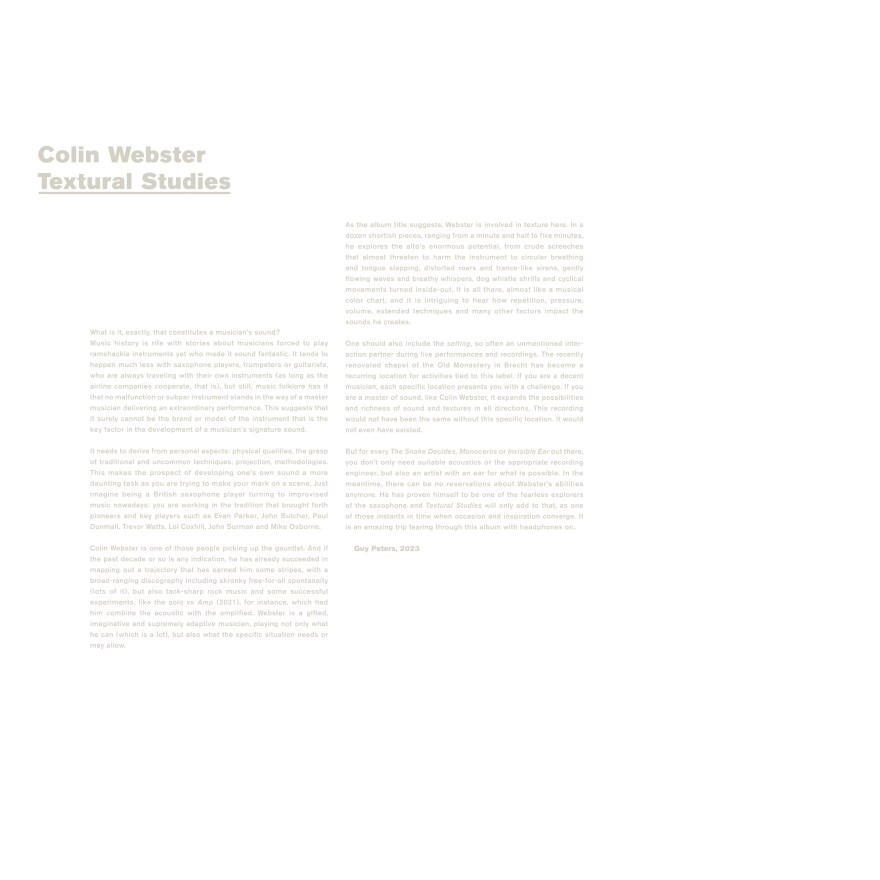
Twaalf ‘Textural Studies’ vinden we op dit album, simpelweg genummerd in Romeinse cijfers. Ze werden opgenomen in het Oude Klooster van Brecht, een prima locatie voor dit soort sessies. Webster gaat er direct in de eerste studie vol in, met sterk ontregelend en overstuurd spel, de longen uit zijn lijf blazend. Circulaire ademhaling is een bijzondere techniek, die niet alle saxofonisten goed beheersen, Webster hoort echter bij diegenen die daar prima raad mee weten, zo leert ons het tweede stuk. Aansluitend gebruikt Webster zijn altsax in het derde deel percussief, zijn knoppen als slagwerk inzettend. Bijzonder en opwindend zijn ook de golvende klankpatronen die Webster in het vijfde, zevende, negende en laatste deel creëert. In het zesde deel komt een ander aspect van de sax aan bod: het spelen met valse lucht, met een mooi subtiel resultaat. Kortom, dit is een zeer afwisselend album, waarin alle verschillende kwaliteiten van de altsax uitgebreid aan bod komen.” Nieuwe Noten
Belgium’s DARK ENTRIES just reviewed VIDNA OBMANA & PBK’ MONUMENT OF EMPTY COLOURS/DEPRESSION AND IDEAL, a 2CD reissued on the Polish ZOHARUM. Available here.
DARK ENTRIES REVIEW : Het Poolse cultlabel Zoharum brengt heel wat heruitgaves uit. Hun heruitgaves van aan dark ambient verwante projecten als het Belgische ritualproject Hybryds of het Britse etno-ambient-project Rapoon waren reeds erg populair. Ze brengen ook al een tijdje heruitgaves van het werk van de Belgische ambient-artiest Vidna Obmana – de naam is Servisch voor ‘gezichtsbedrog’ – uit, een man die trouwens een tijdje bij Hybryds speelde.
Vidna Obmana bracht van 1984 tot 2007 extreem veel ambient-muziek uit, maar verkoos om daarna onder zijn eigen naam Dirk Serries te werken, wat niet betekent dat hij minder productief werd. Wij tellen tussen 1984 en 2007 niet minder dan 87 uitgaves onder de naam Vidna Obmana, al dan niet in samenwerking met anderen, maar het kan zijn dat we sommige uitgaven dubbel gerekend hebben. Het gaat alleszins om heel veel werk, en dan zijn we blij dat Zoharum ons helpt om een keuze te maken in deze overvloed.
Deze heruitgave – de negende al van Zoharum, waarbij u moet weten dat sommige heruitgaves verschillende platen van Vidna Obmana verzamelen – focust op de samenwerkingen met PBK aan het eind van de jaren 80. Het eind van de jaren 80 was sowieso een extreem productieve periode voor Vidna Obmana. PBK is een afkorting van Phillip B. Klinger, eveneens een prolifieke ambient-artiest uit Flint, Michigan in de Verenigde Staten in die periode.
Ook deze heruitgave bevat twee verschillende platen: ‘Monument Of Empty Colours’ en ‘Depression And Ideal’, die allebei in 1989 uitkwamen op cassette, zoals destijds gebruikelijk was voor dit soort muziek. U mag er gerust van uit gaan dat de platen in elkaars verlengde liggen, en dat u dus dubbel kunt genieten van deze box. Het is niet helemaal duidelijk of de opnames het resultaat zijn van de reizen die Dirk Serries destijds naar de Verenigde Staten maakte, dan wel of de twee artiesten cassettes met opnames naar elkaar stuurden die ze telkens aanvulden en terugstuurden.
Languitgerekte tonen – soms zelfs met het gevoel dat je naar een wedstrijd zit te luisteren van hoe lang iemand eenzelfde akkoord kan aanhouden – voeren hier de boventoon. Maar wie aandachtig luistert zal tal van interessante details opmerken, want waar ambient vooral rust en traagheid moet uitstralen, is het vaak de kunst om dat niet al te repetitief of eentonig te doen. Die kunst verstaan Vidna Obmana en PBK, maar dat zal slechts slechts voor geoefende luisteraars duidelijk worden.
We kunnen zeker stellen dat de samenwerkingen tussen Vidna Obmana en PBK een succes waren. Ze hebben trouwens vaker samengewerkt dan enkel op deze twee platen, maar Zoharum vond het legitiem om deze twee collaboraties te bundelen, daar ze tot het meest expressieve werk van de twee heren behoren. Dat wil ik graag geloven, want hoewel ik al behoorlijk wat platen van Vidna Obmana heb liggen, spreekt deze dubbel-cd me in het bijzonder sterk aan.
THE SOUND PROJECTOR REVIEW : Vidna Obmana is, along with Rapoon and Genetic Transmission, an artist whose back catalog this label reissues with a generous hand. The latest package contains two discs, Monument of Empty Colour and Depression and Ideal (ZOHARUM ZOHAR 275-2), both of them collaborations with PBK, the American 1980s veteran Phillip B. Klingler, likewise prolific ambient-noise-electro-acoustic genius who has collaborated with Artificial Memory Trace, Illusion of Safety, Government Alpha, and many others.
Monument originally came out as a cassette in Belgium in 1989 on Dirk Serries’ own Decade Collection label, a vanity press imprint that managed but six releases. I’m certainly enjoying the bleakness and ambiguity of this one, which feels like it has a lot more meat and sinew to it than Vidna manages when left to his own devices. The original cassette had a cover photo where a beckoning cathedral glass tower in the distance was separated from us using a cast-iron gate, suggesting a somewhat foreboding scenario. Even the title ‘Door of Secret Rising’ is part of that scenario, in my fantasy version; perhaps a latter-day Gothic novel of a castle with many hidden compartments. (The digipak of today’s release attempts to emulate the spirit of that image, but it’s too subtle and tasteful). If we are dealing with modern masters of sonic horror here, we can reckon Monument as a successful meeting between Dr Frankenstein and Manfred from the Castle of Otranto. I expect the means and methods (electronics, loops, tapes) are quite simple and basic at some level, but my word how these two manage to imbue their devices with occult powers.
The second disc is occupied by Depression and Ideal, another substantial array with six long-form tracks; also originally from 1989 and released on Mr Klingler’s own PBK Recordings label in California (though there’s also a Canadian version from Freedom in a Vacuum). The original cover art was one of those examples of vague, abstract imagery that was once so much in vogue – maybe a close-up of some granite boulders showing the grain, plus inside some splotches of black blood or Jackson Pollock thrown paint. Where Monument above achieves a lot of its unsettling power through loops and more loops, this Depression item is aiming for a rather terrifying pitch of intensity, slowly ratcheting up the levers of pain one notch at a time. Another characteristic is a certain dissonance, a sense of one too many frequencies competing for the ether; if on Monument the two of them agreed on common ground for their experiments, now the air has soured and the mood has turned to one of brooding contempt. You can start to see why this sort of blank, neurotic and troubling music appealed so much to depressives and shut-ins of the late 1980s, who at the time had no other outlet for expressing their unhealthy mental states; now of course they’ve all become internet trolls and incels. I jest, of course…in all seriousness, these are two great examples of post-industrial art music that tend to reach the parts that even contemporary dark ambient and dungeon synth cannot touch.
I’ve tended to feel a bit surfeited by these many Vidna Obmana projects, but this one will be a keeper and may even make me wish to investigate some of the past output of PBK. From 10th January 2023.
CHAIN D.L.K. REVIEW : “Released by the Polish cult label Zoharum, this double-CD set reissues two seminal works from the late 1980s, initially distributed on cassette — a medium that perfectly matches the raw, unfiltered essence of the tracks.
The first of the two collaborative releases, aptly titled “Monument of Empty Colours”, dates back to 1989, and was the very first release under the imprint of Decade Collection, the private label that Dirk Serries (notoriously the man behind Vidna Obmana darkening curtains) made for some stuff signed under the seal of this moniker. Imagine a sonic cathedral, echoing with prolonged, haunting tones that make you question whether you’re listening to music or experiencing a spectral presence. The Belgian ambient maestro Dirk Serries collaborated with PBK (acronym of Michigan-born experimental sound artist Phillip B. Klingler) to create an atmosphere thick with eerie loops and lingering harmonies. The album embodies a mysterious, almost gothic quality, besides being a possible forerunner of what was labeled as dark ambient some decades later. Some listeners could feel like being in a forgotten, abandoned chapel where every sound is a ghost of its former self, whispering secrets through decayed frequencies.
If “Monument of Empty Colours” can be matched to an imaginary (or concrete!) haunted cathedral, “Depression and Ideal” could be its dilapidated crypt. The second CD in this collection intensifies the experience, with six long-form tracks that slowly ratchet up the tension. Released on PBK’s own self-named label (but I saw that there should have been a second edition on the Canadian label Freedom In A Vacuum) in 1989 as well, the album utilizes dissonant soundscapes and overlapping frequencies to evoke a sense of creeping unease. It’s a perfect soundtrack for your existential crises, providing a soundscape that is both suffocating and strangely cathartic.
Both albums showcase a mastery of ambient sound manipulation. The collaboration between Vidna Obmana and PBK is seamless, blending electronic loops, tape recordings, and ambient noises into a cohesive, unsettling whole. It’s a testament to their ability to transform simple sound sources into complex, emotionally resonant compositions. The original recordings’ analog warmth adds an extra layer of texture, giving the music a timeless quality that digital clarity often lacks.
Ironically, despite the intense melancholy and darkness that permeates these tracks, there’s a peculiar comfort in their predictability. You know that each track will take its time to unfold, much like a dreary yet familiar rainy day. It’s music that doesn’t rush to its conclusions but instead revels in the slow, almost torturous development of its themes. For listeners, this can be oddly reassuring—a sonic equivalent of knowing that at least the storm outside is consistent, even if it’s bleak.
In conclusion, “Monument of Empty Colours” and “Depression and Ideal” is not for the faint of heart. It’s a demanding listen, one that requires patience and a taste for the somber. But for those who appreciate the darker side of ambient music, this reissue is a treasure trove of moody, introspective soundscapes. Whether you’re a long-time fan or new to the works of Vidna Obmana and PBK, this double-CD set is a monument to their enduring legacy in the ambient genre.”
The Free Jazz Collective (USA) just reviewed KODIAN PLUS’ Disengage release, along with KODIAN TRIO’s BLACK BOX release on Raw Tonk Records. What a nice review so time to highlight this 2023 release once again. Available through our bandcamp. And read the full double review here.
Lisle, Serries, and Webster brought in brass player Charlotte Keeffe and pianist Martina Verhoeven to form Kodian Plus, an expanded group recorded a blazing studio session (here’s hoping there are also live sets waiting to be released). Keeffe has been, for me, the discovery of the decade. A dynamic player with a clear vision, she matches Webster for sheer inventiveness, both of them playing with breath, valves and keys, and tones to make radical, dramatic sounds and melodic lines. Verhoeven, Serries’s spouse, has played with Serries and Webster in various free jazz lineups for over 10 years. Although she also plays bass and cello, on Disengage, Verhoeven only plays piano, although that phrasing greatly diminishes what she does with the instrument. Like many of her contemporaries, the piano is a whole instrument, not merely a set of keys at the end. And so, like Serries, Webster, and Keeffe, she almost takes the instrument apart sonically and reassembles it, component sound by component sound. After some languidly paced explorations, the quintet burns brightly, pulsating and boiling over with so much energy, it should leave any listener buzzing, eager to catch them as soon as possible.
On May 27th Fred Kellogg celebrated the 25th anniversary of his excellent FREE JAZZ WITH FRED radio show on KAOS Olympia 89.3FM. Fred has been a great supporter of our label in the past years and on this show he played some of his favorites from the label. Thank you, Fred !

 dirkserries.com