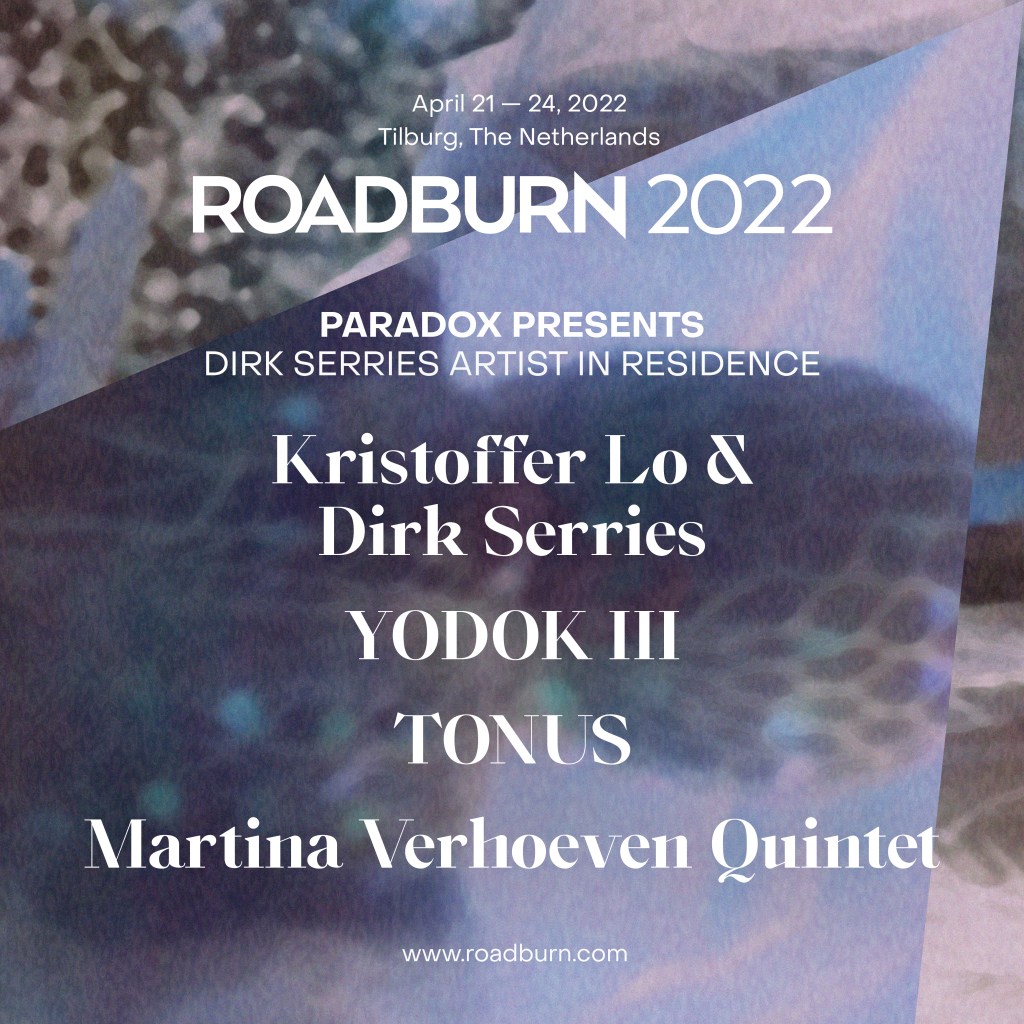
A New Wave Of Jazz’s curator DIRK SERRIES receives an unique opportunity from the magnificent ROADBURN FESTIVAL in conjunction with jazzclub PARADOX in Tilburg to exhibit during the 4 days of this festival what he has been creating over these 38 years in experimental, avantgarde, electronic and free-improvised music.
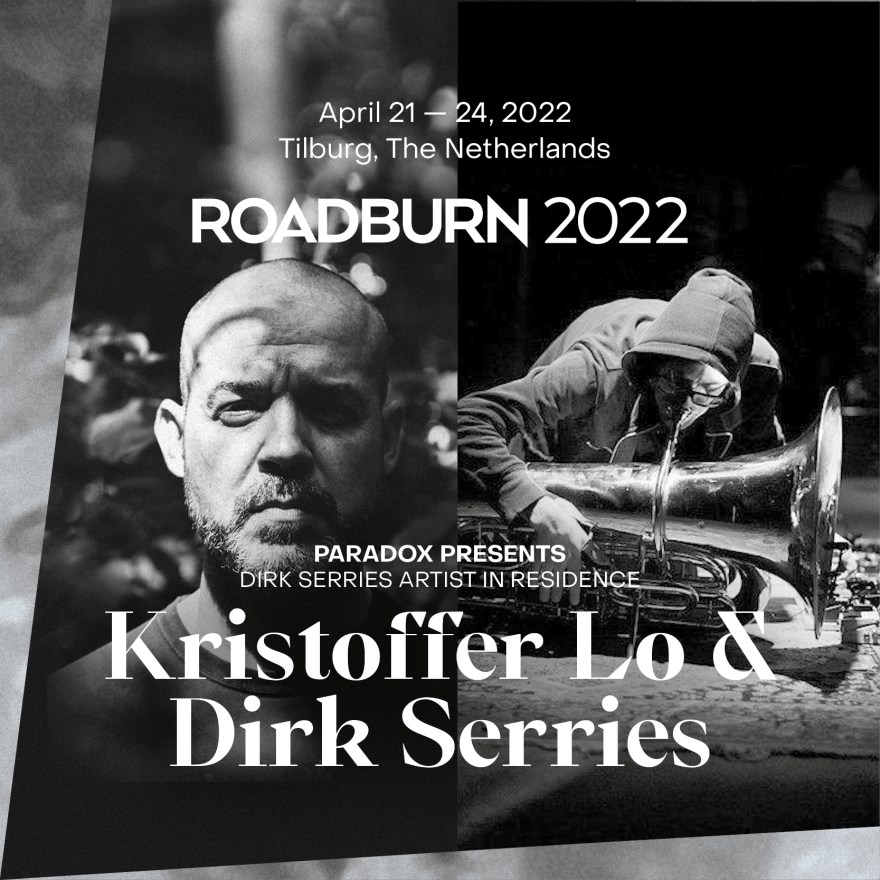
APRIL 21. The first performance will see Dirk team up with fellow YODOK III member, Kristoffer Lo. Having previously collaborated separately with the ‘other’ third of the band, Tomas Järmyr for The Void of Expansion, it was surely only a matter of time before this pairing would come together too. Dirk will play the electric guitar, whilst Kristoffer will perform with an amplified tuba and flugabone, turning their instinctive passion for melancholic, cycling harmonies into an ambient drone requiem that will mesmerise with its utter beauty.
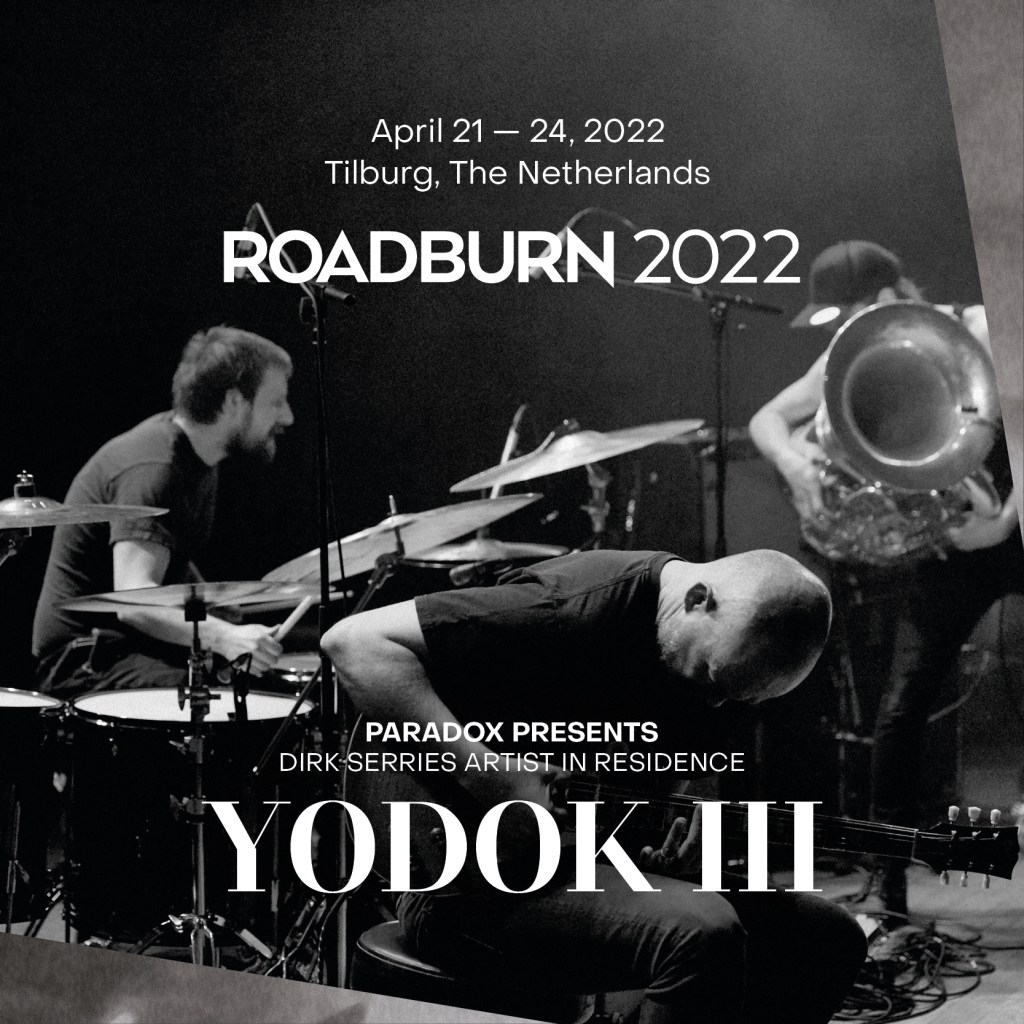
APRIL 22. All three members of YODOK III will come together for a performance on the Friday – bringing together this improvisational ensemble in an intimate setting that is perfect to see them at the height of their powers. YODOK III is a band that thrives on the adrenaline of improvisation, and the interaction and momentum that it brings. Do not miss this special performance that is sure to be dynamic, engaging and truly transcendental.
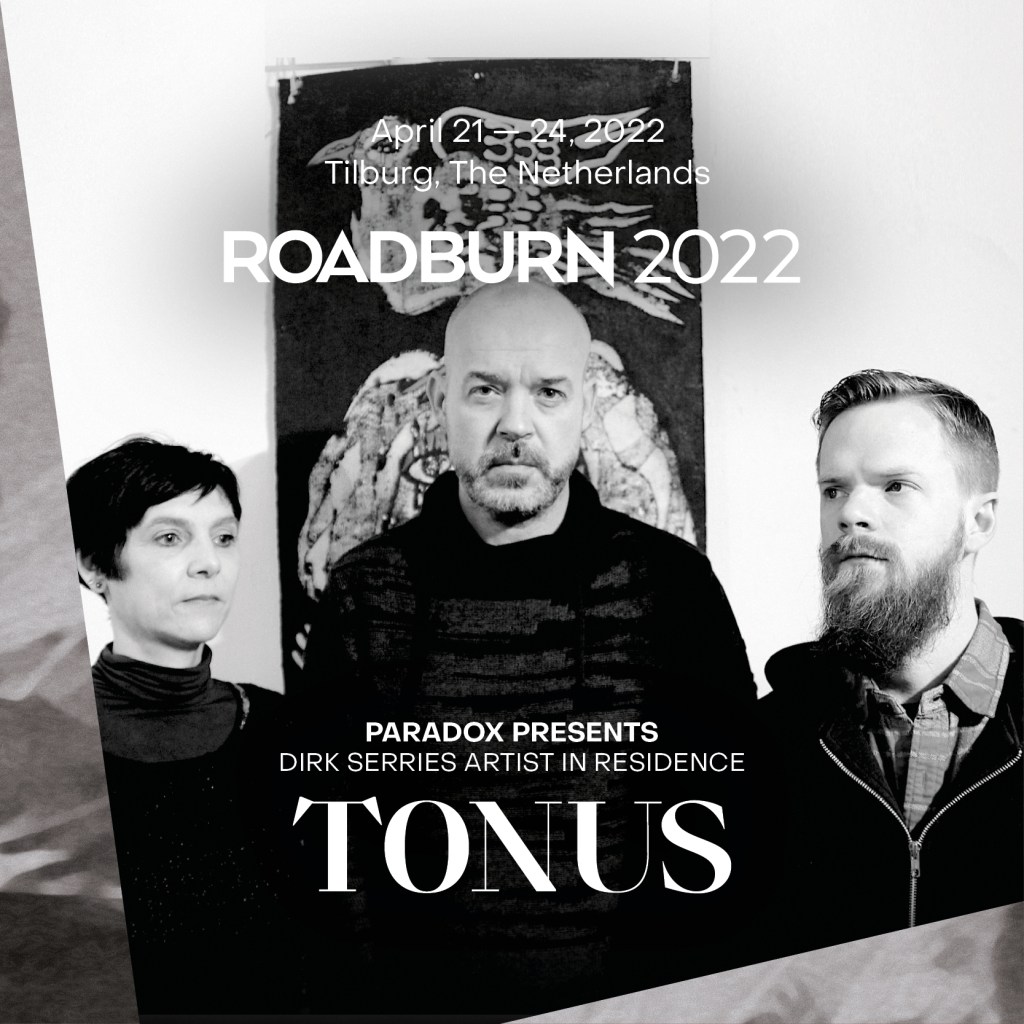
APRIL 23. Saturday will bring a performance by TONUS – Dirk’s minimalist ensemble that has a constantly evolving line up (this performance will feature Martina Verhoeven on piano, Colin Webster on saxophone, and Tom Malmendier on drums alongside Dirk). Describing it as “an exercise in discipline and anticipation while controlling the clarity, sustain and effect of each single note played” – we can’t wait to experience TONUS in person. TONUS will perform a brand new piece that blooms outward from a piano-led focal point. As a counter to the electronic-driven work that Dirk is best known for, TONUS offers an acoustic equivalent, and an opportunity to fully immerse ourselves.
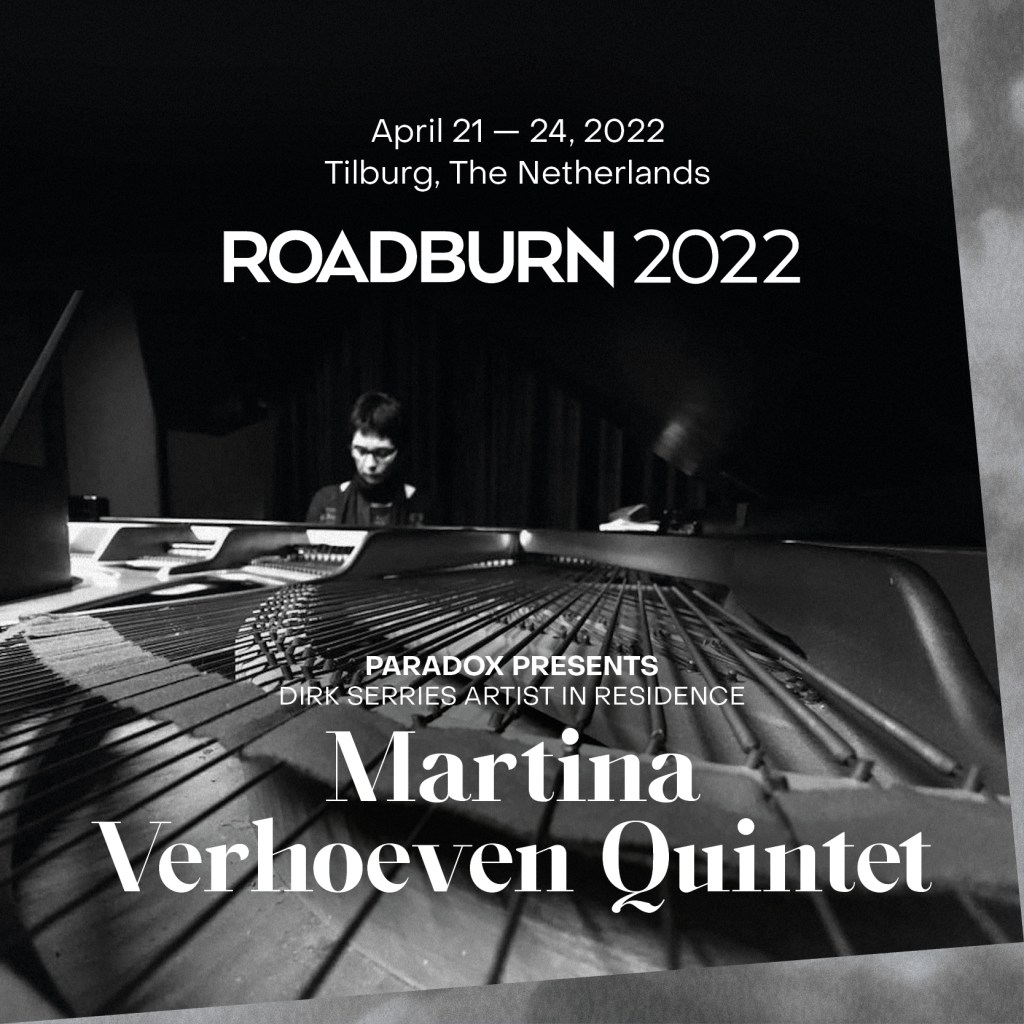
The grand finale of Dirk’s residency is the Martina Verhoeven Quintet. Dirk runs a record label, A New Wave of Jazz, which focuses on his quest for free improvised, avant-garde and free jazz music – this curiosity and passion shines through on the final piece of this puzzle. The quintet is built around the piano virtuosity of polymath and multi-instrumentalist, Martina Verhoeven. The assembled musicians – Dirk on acoustic guitar, Onno Govaert on drums, Gonçalo Almedia on double bass, and Colin Webster on saxophone will create a high tension, free improvisation performance led by Martina’s energetic and unique piano playing.
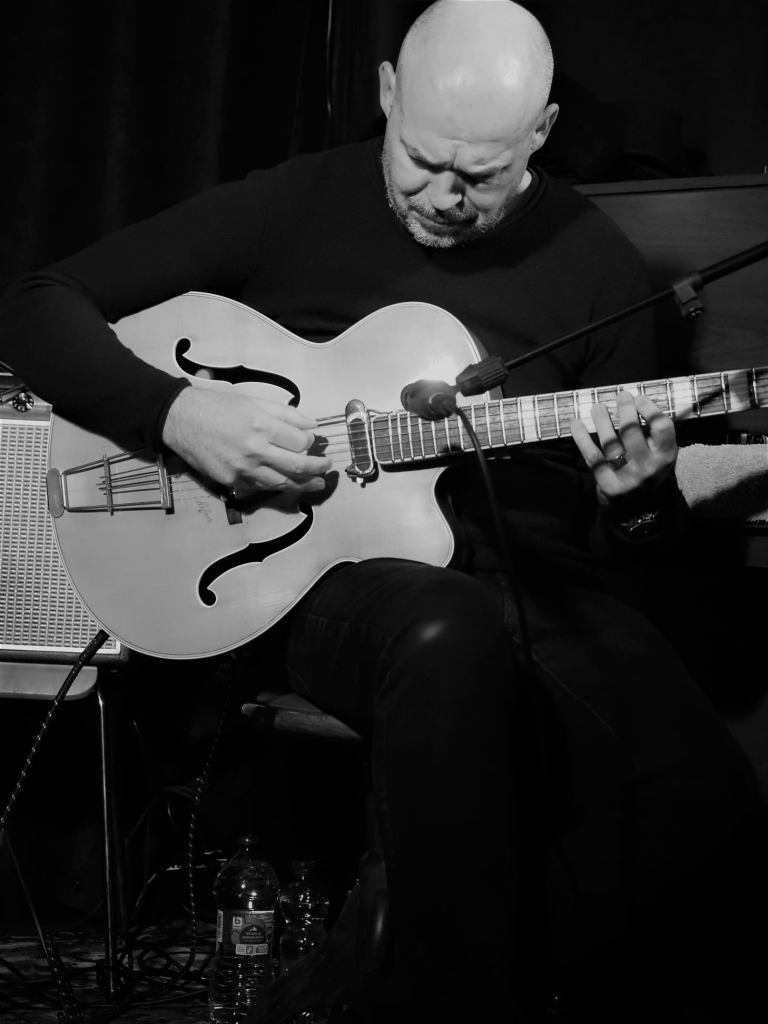
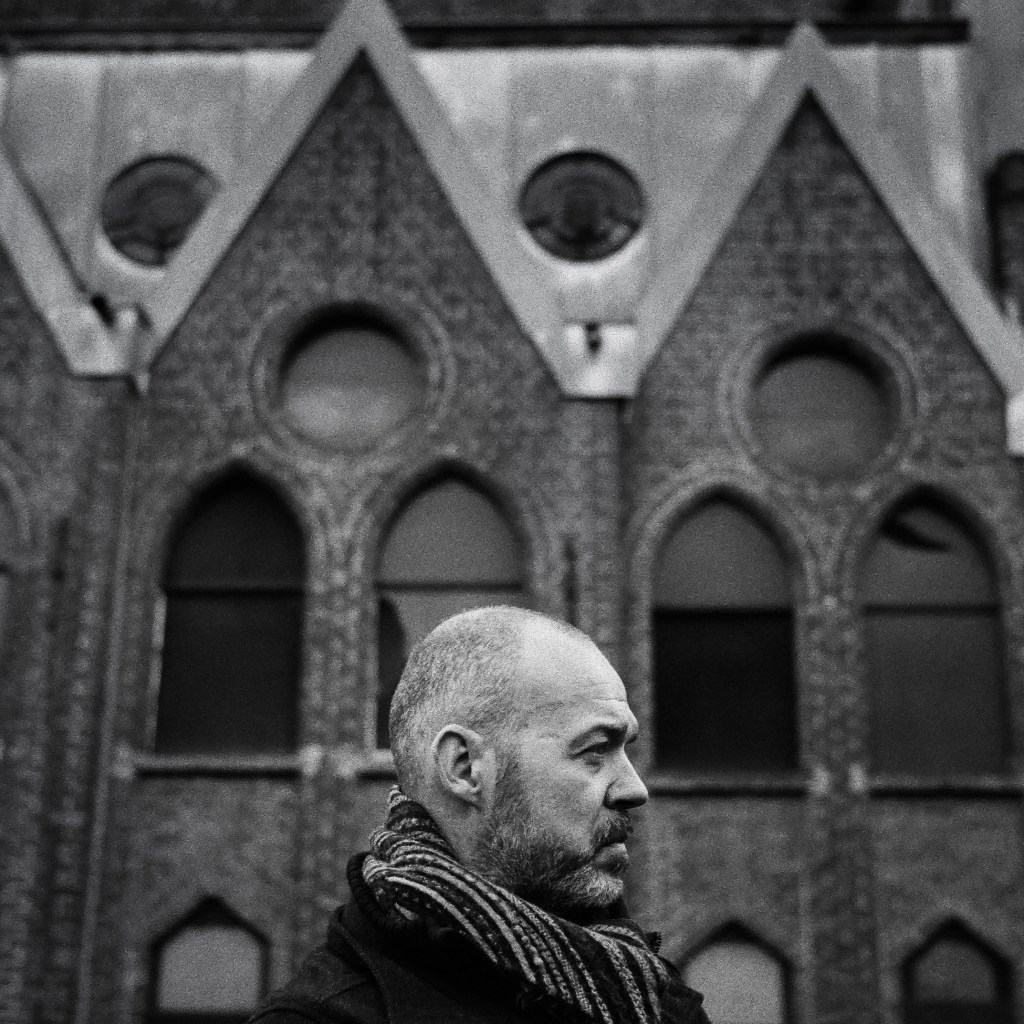
Label curator DIRK SERRIES got interviewed by JAZZ BLUES NEWS on being an improviser and ‘guitarist’.
photo by Jef Vandebroek.
Jazz interview with jazz guitarist Dirk Serries. An interview by email in writing.
JazzBluesNews.com: – First let’s start with where you grew up, and what got you interested in music?
Dirk Serries: – I grew up in Hoboken, a small town very close to Antwerpen (Belgium). As a young kid, I loved, and still do, movies and movie soundtracks. I listening to a lot of Ennio Morricone records back then. When one of those records skipped one day and got in a sort of lock groove, I got truly obsessed about it, it triggered my early fascination for repetition, loops and cycling structures. The beginning of all.
JBN: –How did your sound evolve over time? What did you do to find and develop your sound?
DS: – This has been a process of years and I still think it isn’t finished yet, and luckily so as this is essential to the growth as an artist. But definitely my own style of working with minimalism and cycling structures in the first twenty years came to completion after hours of hard work in the studio, finding and controlling the techniques to work with, whether with synthesizers or the electric guitar. Naturally over the course of these two decades, interests, fascinations and inspirations expand and grow, and therefor the process of learning and exploring continues.
JBN: – What practice routine or exercise have you developed to maintain and improve your current musical ability especially pertaining to rhythm?
DS: – Never have been found of rehearsals. I consider myself more as a sound explorer. Finding the right tone, sound and color for my instrument is way more essential to my ability as a performer than to learn playing techniques on the guitar. I mean the techniques come naturally by trial and error. But the sound is so vital for myself to feel comfortable with the guitar, knowing that I have a solid tone which is diverse and compatible with my own style of playing or where I want to go during the improvisation. Rhythm has actually never been a relevant part in my playing, don’t like the obvious tempo of rhythm so here the choice of whom you work with is vital to this. My favorite drummers are those who think in abstraction and work around the notion of being trapped in a full-on 4/4 or repetitive groove. Never say never but I don’t see myself being a rhythmic guitarist.
JBN: –How to prevent disparate influences from coloring what you’re doing?
DS: – I think it’s impossible not to be influenced by something or somebody, considering how rich and full our musical history is. The trick is not to copy but use that influence to your own benefit, to apply that admiration in order to create your own specific style and way of making and playing music. This is of course the hard way but definitely the most rewarding one.
JBN: –How do you prepare before your performances to help you maintain both spiritual and musical stamina?
DS: – I used to have a strict regime when I was still working with structured and scored music, to the degree of being a perfectionist and control-freak. However, this ruined completely the pleasure of creating and performing. Discovering my own ability to improvise and avoid any kind of strict preparation, made me re-discover that enjoyment, the beauty of instant composing by improvisation. The thrill of creating together from scratch without having any rules or prepared structures is just a blessing and an experience that goes beyond any of my previous works, no matter how successful they were and still are.
JBN: –What’s the balance in music between intellect and soul?
DS: – For me personally music comes from the heart, hardly any conceptual background or motivation. Of course, you do think about visualization, on how to present your musician and with whom you want to collaborate but never liked the idea of attaching my music to an intellectual concept. Always felt and still do that such context would only diminish the spontaneity.
JBN: –There’s a two-way relationship between audience and artist; you’re okay with giving the people what they want?
DS: – Here too I personally don’t think about it too much before, during and after concerts. For me the essence of playing live and collaborating on the spot with fellow musicians is the main priority, the goal and the thrill of the live creation. If audiences are willing to go along with us in this adventure, great and of course you do get a boost when you hear now and then an ecstatic shout from in the audience. But within the free improvisation, I feel, it’s about that live momentum, communicating and creating together and I can only hope people will follow us in this quest.
JBN: –Please any memories from gigs, jams, open acts and studio sessions which you’d like to share with us?
DS: – I don’t think I can. Of course, you’ve concerts where everything works but I firmly believe that every live concert or studio session is essential to whom you are and how this will reflect on what follows next. None of the concerts I’ve done I take for granted but enjoy every second of it.
JBN: –How can we get young people interested in jazz when most of the standard tunes are half a century old?
DS: – What surprises, even disappoints, me is that the younger generations hardly go on a search to discover music which might appeal to them. I feel also that music in general has devalued to a level where it’s just part of the fabric, a form of superficial entertainment. Naturally you do have genres which are solely for that purpose but we’re talking here about (free)jazz, classical music, avant-garde, etc. and therefor it really blows my mind that people just don’t have the interest/motivation anymore to go out and discover new things, like the time when you went to a record store to search for intriguing music. Also, it really shocks me when concerts these days are just moments where people come together to socialize and not to really experience the magic of music, hence all the irritating talking of people during. Luckily in the free impro scene audiences are very attentive, it seems that this movement still draws the right people and perhaps it’s the degree of difficulty that selects and invites.
JBN: – John Coltrane said that music was his spirit. How do you understand the spirit and the meaning of life?
DS: – True. I do experience this the same way. Not religiously but music is part of my DNA, this is I live and breathe. I can’t think another way of how to live my life, to be honest. Naturally over the course of your life you do need to adjust here and there the degree on how far you led music take over, and sometimes you do need to take a step back as operating in the music business – no matter how independent or small the scene is, it’s a pretty hard and by moments very frustrating job. But the magic of music itself each time brings me back to where it pleasantly dominates my life. But honestly it’s sometimes quite Kane and Abel.
JBN: – If you could change one thing in the musical world and it would become a reality, what would that be?
DS: – That it would be less about money and more about integrity and the focus on the art itself. This way I firmly believe that way more interesting artists, musicians and bands will get a chance to introduce their music to the public. Now it’s all about the same usual suspects and what brings in the money.
JBN: –Who do you find yourself listening to these days?
DS: – I always had an eclectic choice in music and still do, like to mix up the styles I listen to daily. But there’s never a day that passes by without listening to one or two favorite albums from my childhood. I grew up with post-punk and new wave. But also, classical music and jazz are permanent in my playlists.
JBN: –What is the message you choose to bring through your music?
DS: – Let me be so free to quote writer Guy Peters: “Improvising musicians may or may not be overtly political but they subscribe to a set of values (not matter how ‘free’ the music sounds) and fundamental issues that somehow have become mutually exclusive with those of an economy that mainly serves itself. Mutual respect, unconditional trust, an open attitude, self-reliance, creation, invention, support and letting yourself be heard. These are the key ingredients of free music. At the same time these are the qualities that leaders who frown upon the arts, regard with suspicion, just like they do with every unruly voice.” Culled from his liner notes from ‘Obscure Fluctuations’ by John Dikeman, Steve Noble and myself for the TROST Records label. That says enough, me think.
Belgium’s JAZZ & MO magazine just reviewed JOHN EDWARDS & DIRK SERRIES’ ‘Melancholia’ album in their latest printed edition. The album is available from our store and on bandcamp.
“In zijn treffende hoestekst roept Guy Peters een interessante vraag op : het album heet Melancholia maar Peters zelf hoort vooral ongebreideld speelplezier. De vitaliteit van het duospel en de zucht naar avontuur zijn onmiskenbaar, dusdanig zelfs dat melancholie zo’n beetje het laatste is waaraan je bij deze muziek denkt. In elk geval is de plaat een ontmoeting tussen twee verwanten die elk uit een hoek van de experimentele jazz komen, en tussen twee instrumenten die net zo goed verwant maar erg verschillend zijn. Het woord experimenteel is hier zonder meer op zijn plaats. Dit is muziek waarvan de uitkomst niet op voorhand vaststaat, muziek die gebeurt. De koers wordt al spelende bepaald. Naar mijn idee mondt die aanpak op deze cd vooral uit in een onderzoek naar de textuur van klank. Er zijn meerdere momenten waarop het duo verrassende en soms zelfs overrompelende samenklanken vindt, en in de tussentijd wordt gezocht. De klankrijkdom is een ding, maar als luisteraar deelgenoot of zelfs medeplichtig mogen zijn in dat proces is toch de grootste sensatie” Jazz & Mo – Belgium
TOM JACKSON & COLIN WEBSTER’s THE OTHER LIES gets a fine review on Canada’s JAZZWORD by Ken Waxman. The album is of course still available from our store and on bandcamp. BANDCAMP is by the way waiving their revenue shares once again so that every penny goes directly to the musicians themselves. We’re offering you a 35% on individual digital or physical releases and a 60% discount on the full digital catalog. Thank you for your support !!
“The nub of linearity also occasionally peeks through the overblowing and segmented tones that make up The Other Lies. Jackson who has been part of The Apartment House and Webster who plays with Daniel Thompson and others, use every part of their respective instruments to source new and unique textures. Yet by the time they reach the concluding “VI” track, near classic textures are heard among clarion vibrations from the clarinet and resonating low pitches from the baritone saxophone. This confirms that linear harmonies and gentling balance are also present. Otherwise what lies in The Other Lies are mini essays in extended techniques with shrill and staccato clarinet lines butting up against alto or baritone tongue slaps, continuous blowing and split tone fragmentation. A few fowl honks suddenly increase the tempo in parts, and brief silent interludes prolong the sound descriptions. “I” sets up the improvisations at greatest length, starting with both overblowing in double counterpoint at great length. Breaking apart into altissimo clarinet squeals and grainy alto saxophone scoops and split tones, Webster soon joins Jackson at the highest reed pitches. Throwing the connective ostinato back and forth, the two reach a climax of harder, heavier and more segmented vibrations.”
MusicZine talked to DIRK SERRIES on Zoom about his label, his new collaboration with TRÖSTA, YODOK III & the free improvisation scene and future works.
MOORS MAGAZINE is catching up with some of our albums from the backcatalog and has been writing some lovely and honest evaluations. Here’re 2 : COLIN WEBSTER & DANIEL THOMPSON – Boskage and SETT – First And Second. Both albums are still available from our store and on bandcamp.
“Als akoestisch gitarist Daniel Thompson en altsaxofonist Colin Webster samen gaan spelen weet je dat je het onverwachte kunt verwachten. Het in juni 2018 opgenomen album Boskage bevat drie improvisaties die behoorlijk wat aandacht en concentratie vergen van jou als luisteraar, maar daar krijg je dan ook wel wat voor terug, want Thompson en Webster zijn twee ongewone virtuozen, die juist omdat ze volledige controle hebben over hun instrument ook de volledige vrijheid durven opzoeken. Dat begint in de eerste improvisatie met wat aftastend uitwisselen van geluiden, maar al snel gebeurt er heel veel en gaan de twee een geweldig muzikaal gesprek aan, dat heftig, maar ook intiem wordt, en laten we vooral niet vergeten, ook bijzonder humoristisch. Luister maar eens naar het begin van de derde improvisatie – dat is niet alleen muzikaal subliem, maar ook geweldig grappig. Zoals wel vaker bij dit soort intensieve improvisaties ontgaat je als luisteraar vrij veel als je er de eerste keer naar luistert, maar als je de moeite neemt dit album vaker te beluisteren zul je merken dat het nog veel geraffineerder en beter in elkaar zit dan je dacht. Spannend van begin tot eind, en veel avontuurlijker dan hier zul je het niet gauw vinden. Voor iedereen met open oren.”
“Sett is een gelegenheidsband met een behoorlijk ongewone bezetting, zelfs voor een free jazz-kwartet. Het gaat hier om twee unieke, eigenzinnige gitaristen, de Vlaming Dirk Serries en de Brit Daniel Thompson (die overigens allebei hun eigen geweldige platenlabel zijn gestart), contrabassist John Edwards en violaspeler Benedict Taylor. Drie Britten en een Belg, maar alle vier uit hetzelfde avontuurlijke hout gesneden. Op dit album hoor je twee sessies van een klein half uur elk die in november 2019 zijn opgenomen, die van de luisteraar behoorlijk wat aandacht en concentratie vergen. Dit is geen muziek voor luie luisteraars of voor mensen die achtergrondmuziek zoeken, laat ik het zo maar zeggen. Muziek voor mensen met open oren en een open geest, die door ogenschijnlijke chaos heen kunnen luisteren en kunnen horen hoe flexibel en soepel de vier mannen op elkaar reageren en met elkaar tot iets spannends en hechtst komen. Luister bijvoorbeeld eens naar het eerste fragment dat ik uit de eerste sett heb geknipt (wat eigenlijk een doodzonde is) en dat begint met wat toch wat op chaos lijkt, maar wat al heel snel naar een hechte samengesmede spannende brok muziek toewerkt. Luister er maar eens een paar keer achter elkaar naar, en je bewondering zal zonder meer groeien.Dat geldt ook voor de fluisterzachte passages, waarbij ik echt op het puntje van mijn stoel zit – de spanning wordt er op die momenten zo fenomenaal mooi ingehouden dat ik echt met open mond zit te luisteren. En als je dan goed luistert kun je soms niet echt thuisbrengen welk geluid nu op welke manier uit welk instrument is ontlokt, en dat maakt het eigenlijk nog leuker. Daarom is het ook eindeloos veel leuker om live bij dit soort concerten aanwezig te zijn, maar een opname als deze maakt veel goed, zeker omdat ook hier weer blijkt dat vaker luisteren nog veel meer details en subtiele geheimen aan het licht brengt. Een juweel van een album.”
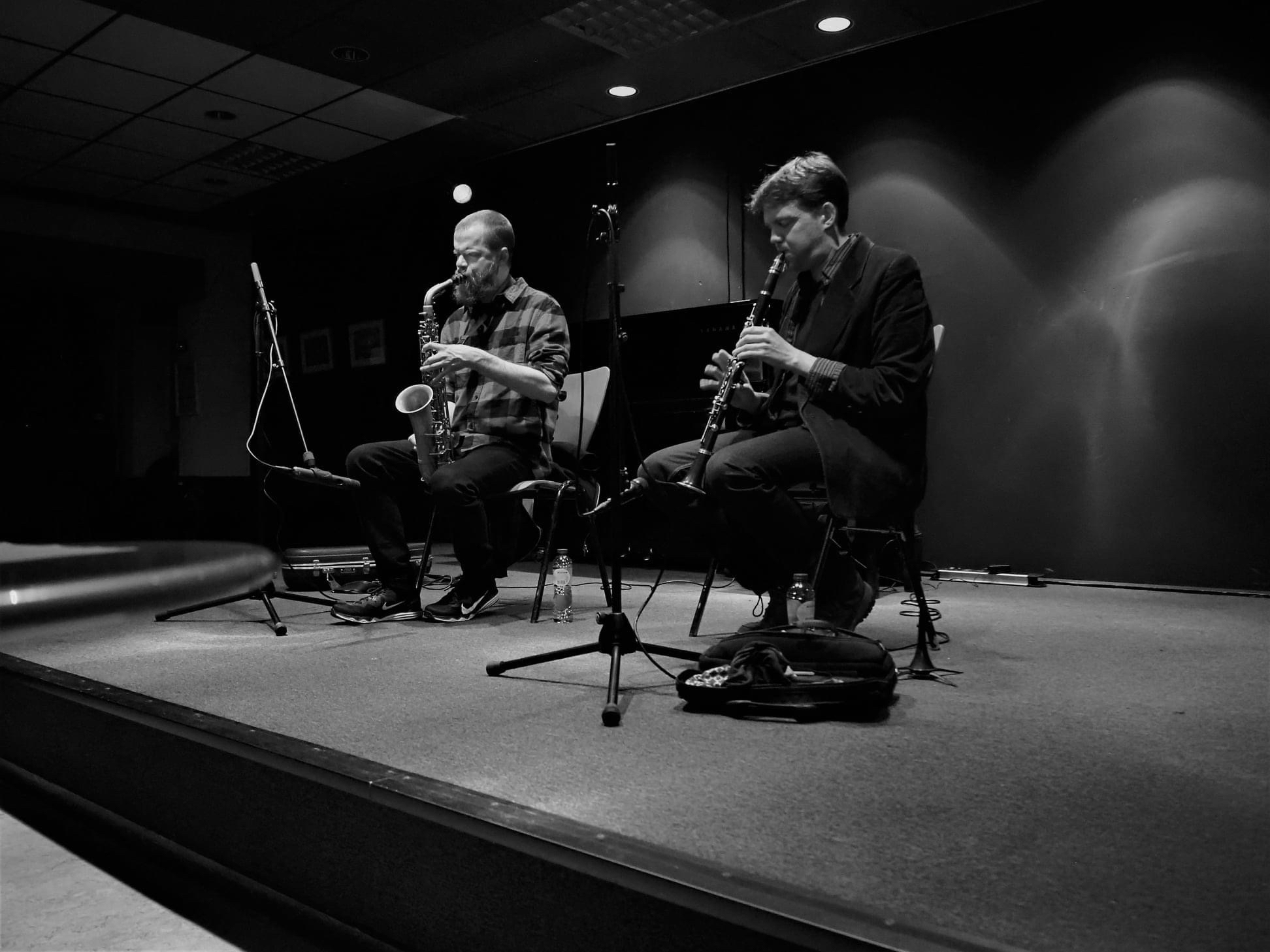
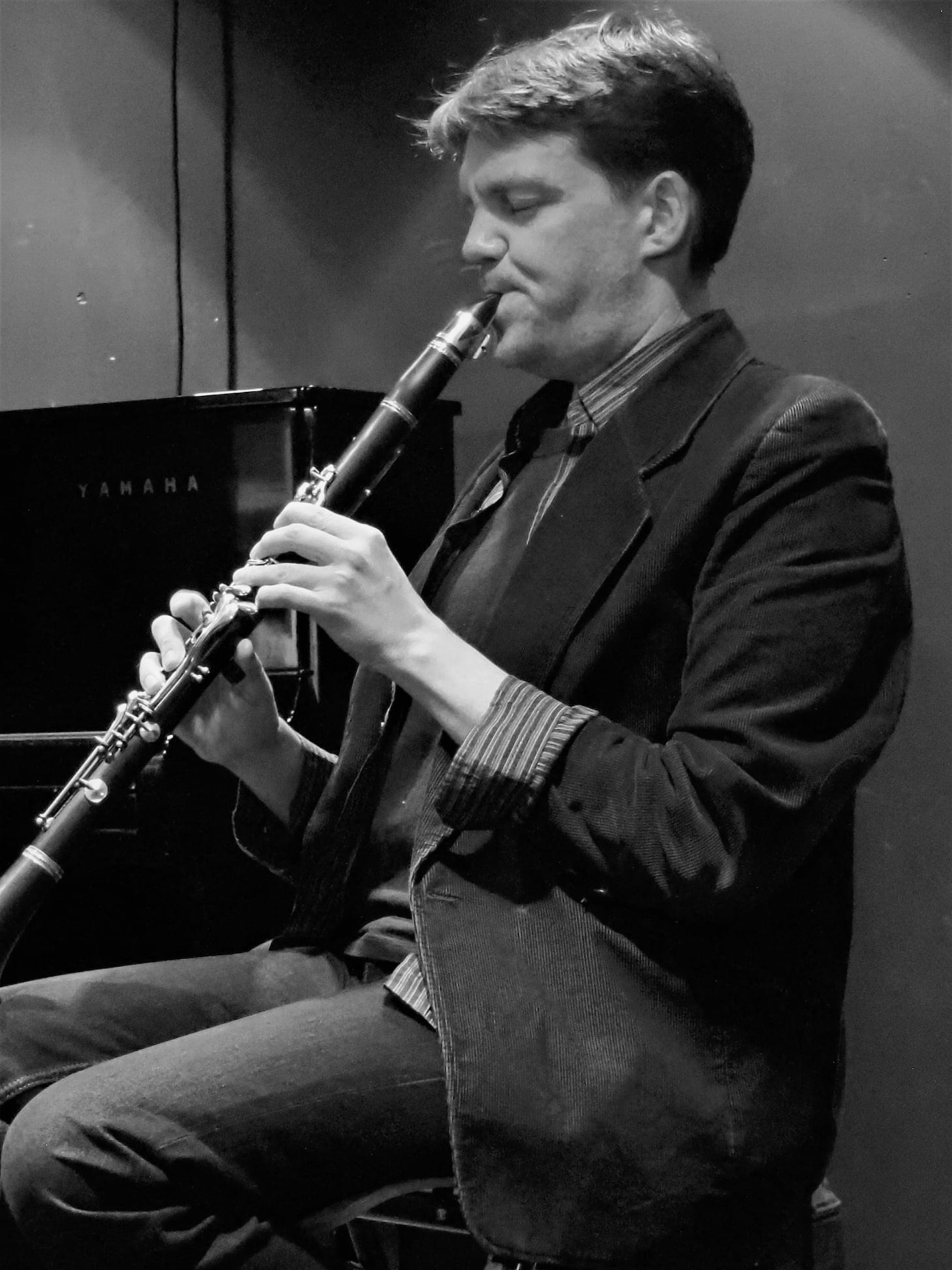
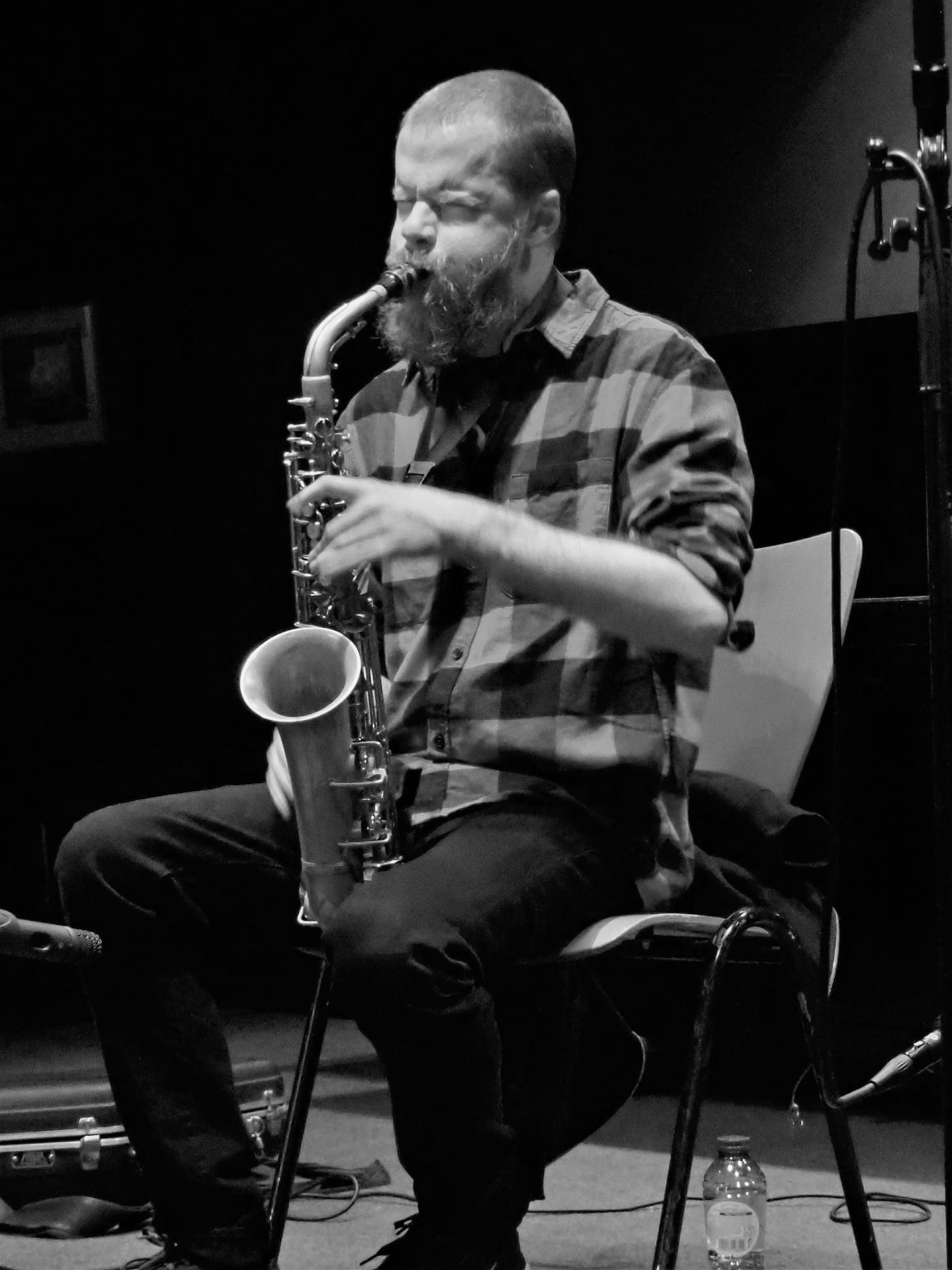
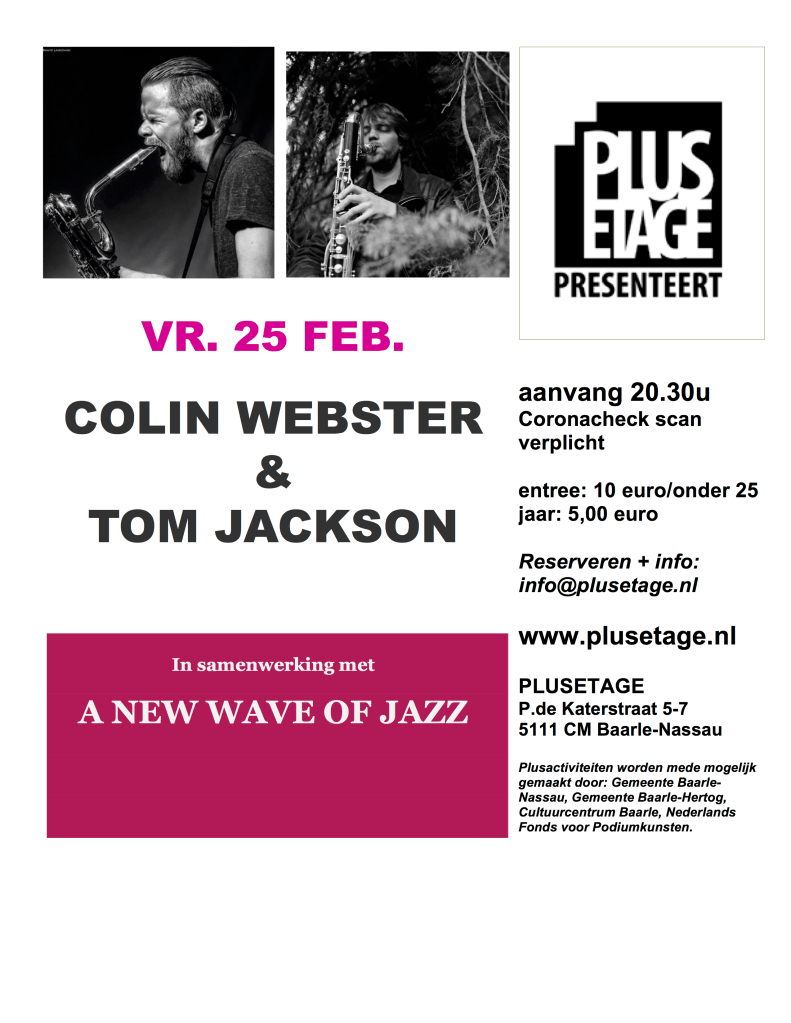
Last Friday we had our 2nd label event at the lovely PlusEtage jazzclub in Baarle-Nassau (NL) with a fantastic duo performance of COLIN WEBSTER (alto sax) and TOM JACKSON (clarinet). Ben Taffijn’s NIEUWE NOTEN wrote a lovely review in combination with analyzing Webster & Jackson’s THE OTHER LIES album. Next up : CHARLOTTE KEEFFE & ANDREW LISLE – April 29th.
photos by Jef Vandebroek
“Twee blazers, als duo, hoor je zelden. Vandaar dat klarinettist Tom Jackson en saxofonist Colin Webster nog nooit samen op het podium stonden of samen een album opnamen, ook al kennen ze elkaar al jaren en wonen ze beiden in Londen. En als Dirk Serries ze niet gevraagd had voor het bij zijn A New Wave of Jazz verschenen ‘The Other Lies’, was het er wellicht wel nooit van gekomen. Gisterenavond waren de twee ook live te horen in de PlusEtage.
Wellicht komt het duo Jackson – Webster wel het mooist tot zijn recht in de fragiele, ingetogen passages, direct al in het eerste stuk op de CD en op menig moment tijdens het boeiende treffen in Baarle-Nassau. Boeiend hoe de klanken in elkaar haken, elkaar kruisend in het hoog. Soms hoor je niet eens of het nu de klarinet is of de altsax. Bijzondere klanken, vaak het gevolg van het op vrij onorthodoxe wijze inzetten van de instrumenten. Met name Webster werkt veel met zijn kleppen, blaast over het riet, lispelt, gromt en sputtert naar hartenlust. Op andere momenten en het tweede stuk voor de pauze tijdens het concert is er een mooi voorbeeld van, overheerst de speelse creativiteit, gaan de twee met elkaar het duel aan in het hoogste register. Al kwetterend en schreeuwend zoeken de heren de grenzen op van hun instrument. Mooi is ook het begin van het laatste stuk in Baarle-Nassau waarin de twee middels circulaire ademhaling een krachtige drone neerzetten, de klanken haken hier volledig in elkaar.
Het album is niet minder bijzonder, neem de verrichtingen in het tweede stuk, waarin we Webster op baritonsax horen (die had hij gisterenavond niet meegenomen). Stugge klanken produceert hij hier, antwoord gevend op Jacksons springende noten. In het derde stuk vallen de slierten noten op die Jackson produceert, krachtig begeleid door de ritmische stoten van Webster op zijn baritonsax en verderop vindt een boeiend treffen plaats tussen klarinet en altsax.”
Tomorrow we are hosting our label event once again in the fantastic PlusEtage jazzclub (they are celebrating their 50th anniversary this year !!!) in Baarle-Nassau (NL) with this prime duo. Early this year we released their debut duo album ‘The Other Lies’ and have been receiving praise and appreciation. So don’t hesitate and join us for a fine evening of free impro chamber music ! Tickets are available through PlusEtage or at the door.
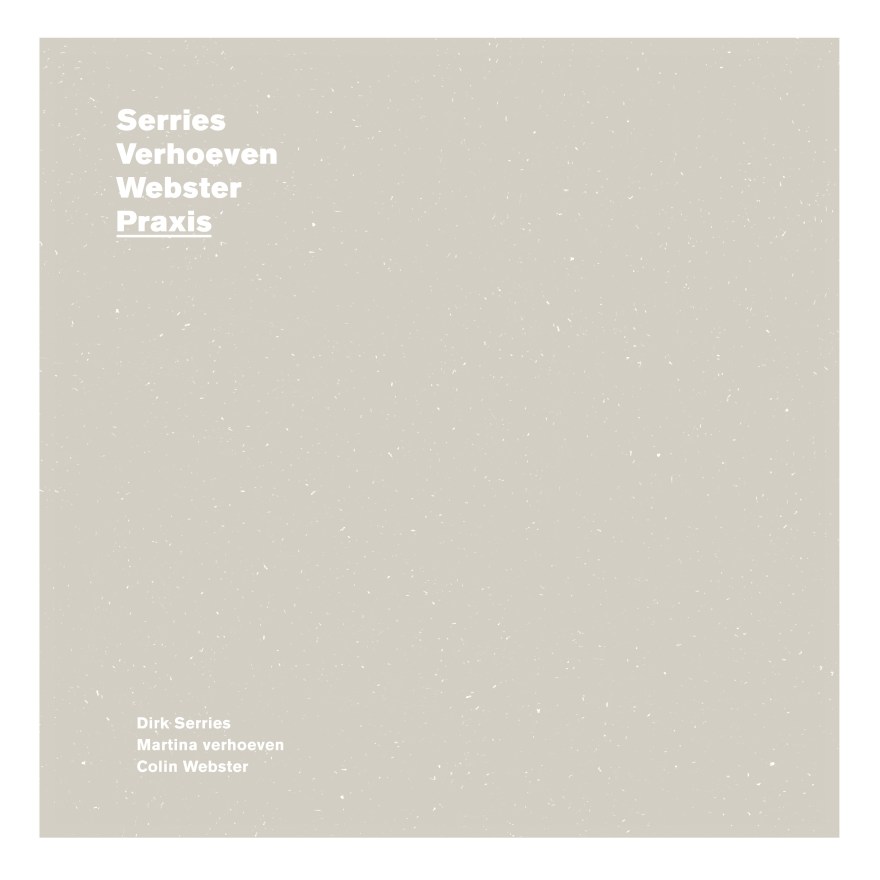
Holland’s MOORS MAGAZINE has been reviewing a significant portion of our backcatalog and here’s a fine one on SERRIES/VERHOEVEN/WEBSTER’ PRAXIS album, released in 2020 and still available from our store and on bandcamp.
“Dirk Serries op akoestische gitaren, Martina Verhoeven piano en Colin Webster op altsaxofoon, dan weet je dat je een bijzondere sessie kunt verwachten. Drie absolute grootmeesters in de geïmproviseerde muziek, die onvoorstelbaar goed naar elkaar kunnen luisteren, en die ook hier weer een muzikaal gesprek met elkaar aangaan waar je als luisteraar alleen maar met open mond naar kunt luisteren. Soms gebeurt er bijna niets, en dan klinkt er een merkwaardig geluid waar op gereageerd wordt – hun instrumenten worden op een totaal onconventionele manier ingezet – je hoort Webster blazen, en ook dat geluid wordt muziek, de klankkast van Serries’ gitaar doet op verschillende manieren mee, net als de snaren, die op de meest ongebruikelijke manieren bespeeld worden. En dat geldt ook voor de piano van Verhoeven, die vaak nog het “normaalst” klinkt, maar die ook geëxploreerd wordt op manieren die niet voor de hand liggen. Spannende muziek, van de eerste tot de laatste noot, waarbij ik persoonlijk de stilste passages het spannendst en het mooist vind. Muziek ook die niet snel verveelt, want juist omdat deze drie zo’n ongewoon muzikaal gesprek aangaan ontdek je bij iedere draaibeurt weer kleine details die je eerder gemist had. Een juweel van een album!”
UK’s Musique Machine continues to support the label with writing lovely reviews about our releases and for this we’re grateful. Here’re two of them. Enjoy and remember that both albums are available from our store and bandcamp.
ANTON MOBIN & MARTINA VERHOEVEN – CURE AND MOUND (CD)
“4 out of 5 rating! Cure and Mound feature two examples of edgy ‘n’ eventful improv for prepared chamber and piano. The CD/ digital download slides in at nearing the eighty-minute mark, and it’s a shifting & darting ride- with both players sparking off each other nicely. The release appears on Belgium based A New Wave Of Jazz- who put out the best in the more difficult, yet often highly creative side of improv and modern composition. The CD comes presented in the labels house style mini gatefold packaging- which all feature minimalistic white texts in grey boxes design, with a write-up inside by Guy Peters. The release comes in an edition of 300 copies- which can be purchased directly from here. The two players here are French improvise/ sound artist Anton Mobin on prepared chamber. And Belgian photographer, bass player and pianist Martina Verhoeven. With the two tracks featured being recorded live in the studio. The release opens with the track “Cure”- which takes up the lion share of this release at just shy of the forty-seven-minute mark. It starts off in a wonderfully manically angular manner with sways of slicing and grating stings, doomy to cascading key hits, blunt bass fumbling’s- all topped with scuttling and knocking detail- managing to feel gloomy uneasy, insect-like, and surreally wavering in its intent. As we move on the pair keep both fleeting and daring in their playing- as we move from stop ‘n’ start piano key chops meet long scraping and knocking tonality. Onto whipping ‘n’ warping bass tone fluctuations topped with all manner key fidgety and scape dart ‘n’ rip detail. Through to the sawing at times almost manically barking chamber tones, that are tempered by clanging key runs. Onto the tolling-yet-darting piano notation, that shifted by all manner of knocks, scrapes, hiss, and breathy grates. Really a marvellous track that keeps you held & on your toes throughout its length. Next, we of course have “Mound”- and this comes in at ten seconds sly of the half an hour mark. We begin with a blend of taut fiddles, scrapes, and rattles- which are surrounded by darting shards of doomy to higher piano key work. As we process, we find a sea of playful key darts and jaunts, scared by whooping bass fumbles and shimmering to dragging tone detail. We have moments of haunting tolling key work which is edged by a selection of unease scrapes, drags and creaks. Though equally, we have moments grating, wavering and fiddling manic-ness. At times it felt like the piano was more formal/ atmospheric on this track, but also, we have lots of great more abstract/ primal playing going on too. The pairing of prepared chamber and piano is certainly an interesting one- and on Cure and Mound both Mobin and Verhoeven make the most of chosen sonic tools, really giving them a workout here. This is certainly a release for those who enjoy the more fidgety and abstract side of the improv form, but I really found the whole thing most captivating and rewarding- with not a dull moment in sight/ ear.” Musique Machine – UK
JOHN EDWARDS & DIRK SERRIES – MELANCHOLIA (CD)
“3 out of 5 rating ! Melancholia is an improv release that shifts( at points) rapidly from starkly felt ‘n’ fraught, to the more manic and detailed. It features two respected euro Avant players- Belgian guitarist Dirk Serries- who also runs the New Wave Of Jazz label and is also behind respected/ inferential ambient project Vidna Obmana. And British double bassist John Edwards- who since the late ’90s has built up a large and respected body of work collaborating with the likes of Evan Parker, Lol Coxhill, Tony Levin, and many others. The release appears as either a CD( which I’m reviewing) or a digital download. The CD comes presented in New Waves of Jazz’s house style grey box and white text mini gatefold- with a write up in the middle by Guy Peters. The CD pressing is ltd to just three hundred copies. The album features two number tracks- with these each hitting between the twenty and twenty-four-minute mark. First up we have “I”- this opens with a nicely taut-yet-stark blend of sudden bass neck fumble, jugged and darting guitar strum & scuttle. As the track progresses the more manic side of proceedings comes to the fore- with rapidly bass shifts and bays, detailed and complex guitar saws and strums. As we move on the track dramatically shifts between the sparser and moodier, to the more busy and detailed- within both settings we find moments of compelling angularity, fraught emotionality, and even fleeting moments of the more playful/ quirky. Next, we have “II” which is the longer of the two tracks- we move from the sudden busy ‘n’ jagged guitar motifs and lightly bounding to more buzzing bass tones of the start. Onto the tensioned & thickly droning low end meets fiddling and forking guitar tones, though to the rapid blends of strum, knock, and bass bow. We once again have more spaced/ paired back moments of sly guitar saw ‘n’ slides, and bass scab- but equally we have the more manic busy side of the coin too. With the track playing out with a wonderful searing and oddly grooving, throb, scab, and purr section. Melancholia presents us with forty-five minutes of shifting, at points emotional improv- with both players wonderfully complementing each other nicely.” Musique Machine – UK